No Houris for an Indeterminate Duration
If there’s one good thing about the Moussaoui verdict, it’s that he’s on his way to Florence, Colorado, a “supermax”, or “control unit” federal prison. Control unit prisons are all solitary confinement, with cells typically measuring six by eight feet, wherein the prisoner spends 22 to 23 hours of each day. There’s no congregating of any kind between prisoners, not for meals, not for work, not for religious services. USP Florence was “purpose built” as a control unit lockup to replace the one at Marion, Illinois, where the Bureau of Prisons had made it a practice to send its most difficult prisoners, those causing the most disruption to operations elsewhere in the system, and one fairly notorious for prisoner abuse. Florence is modelled on California’s Pelican Bay “Security Housing Unit,” and has as a primary feature a high level of automation to reduce direct prisoner-guard interactions. In other words, ol’ Zach’s going to spend the rest of his life in the most appropriate temporal conditions to his crimes, although with no further consideration of his evident insanity than that he won’t be executed.
01 May 2006
Pope Gets a Taste of Tibet
Now Benedict knows how the Dalai Lama feels, sharing the experience of having China appoint a bishop for him, the way Tenzin Gyatso found himself with a new Panchen Lama in 1995. Of course, it would be more analogous if China’s latest religious appointment was a Cardinal, and one of the papal succession electors, but you get the picture. I’m betting the Vatican rolls over on this one.
Now Benedict knows how the Dalai Lama feels, sharing the experience of having China appoint a bishop for him, the way Tenzin Gyatso found himself with a new Panchen Lama in 1995. Of course, it would be more analogous if China’s latest religious appointment was a Cardinal, and one of the papal succession electors, but you get the picture. I’m betting the Vatican rolls over on this one.
What Have You Done for Me Lately?
That whacky renegade, Nationals Senator Barnaby Joyce, shows his iconoclastic side again, proposing that Australia mine Antarctica before everyone else gets in there first and takes all the gold and fish and stuff. This government is all about “show me the money.” Whatever they can get now, without any consideration for the future, is where their policies will be directed. Sell Telstra – now! Sell Medibank Private – now! Dump coal in favor of nuclear power – now! Dig up Antarctica – now! There are two rationales operating here. The first is that what’s good for business is good for the nation. The second is keeping the economy running with low inflation and low unemployment keeps the voters on-side. There’s truth in both things, but both operate ultimately in service to corporate control of government. Businesses, big businesses, are who’s being kept on-side, not the lower or middle classes, and business operates on the principle of “what have you done for me lately?” and that’s never been quite so true as it is now, where so much of any businesses revenues must be spent on shareholder return and executive compensation instead of on the business itself. So long as this government operates in service to that structure, they will sell out the future. (Maybe Joyce should start looking off-planet for commercial opportunities, unless it’s just about the fish.)
That whacky renegade, Nationals Senator Barnaby Joyce, shows his iconoclastic side again, proposing that Australia mine Antarctica before everyone else gets in there first and takes all the gold and fish and stuff. This government is all about “show me the money.” Whatever they can get now, without any consideration for the future, is where their policies will be directed. Sell Telstra – now! Sell Medibank Private – now! Dump coal in favor of nuclear power – now! Dig up Antarctica – now! There are two rationales operating here. The first is that what’s good for business is good for the nation. The second is keeping the economy running with low inflation and low unemployment keeps the voters on-side. There’s truth in both things, but both operate ultimately in service to corporate control of government. Businesses, big businesses, are who’s being kept on-side, not the lower or middle classes, and business operates on the principle of “what have you done for me lately?” and that’s never been quite so true as it is now, where so much of any businesses revenues must be spent on shareholder return and executive compensation instead of on the business itself. So long as this government operates in service to that structure, they will sell out the future. (Maybe Joyce should start looking off-planet for commercial opportunities, unless it’s just about the fish.)
Abuse
The Bush government can’t release the Guantanamo prisoners because: (a) they’ll be abused back in their home countries, (b) they’ve been abused in Guantanamo, (c) they’ll be able to sue the U.S. government for false imprisonment, or (d) now they really are terrorists. Hint: it’s a trick question.
The Bush government can’t release the Guantanamo prisoners because: (a) they’ll be abused back in their home countries, (b) they’ve been abused in Guantanamo, (c) they’ll be able to sue the U.S. government for false imprisonment, or (d) now they really are terrorists. Hint: it’s a trick question.
28 April 2006
”Please Use the Word ‘Girt’ in a Sentence”
When I was interviewed for my citizenship application, I was helpfully provided with a copy of the list of Responsibilities and Privileges with which becoming an Australian would endow me, things like Registering to Vote and Running for Office, just to refresh my memory, since I was expected to have learned them all off by heart prior to coming in. At the interview itself, I was required to recite two from each section. (Naturally, one of the privileges I provided was the trickiest to articulate without sounding like some kind of Bali drug smuggler: If I get in trouble overseas, I have the privilege to call for diplomatic assistance – what was I thinking?) I passed anyway. Because I’m a native English speaker, I probably wouldn’t have any trouble with the rest of Andrew Robb’s citizenship test, although the spelling variations do still catch me up sometimes, despite all the English English literature I’ve read, as well as some of what I perceive to be archaic usages still in force here, mostly prepositional. I am not convinced, however, by Mr. Robb’s assertions regarding the use and purpose of the test he’s proposing.
He says it’s for “prospective migrants,” which means it isn’t a citizenship test per se at all: it’s an immigration filter. Prospective migrants who want to become citizens will indeed want to attain a level of conversational English language skills to ease their transition, if they haven’t already, while prospective migrants who don’t want citizenship or aren’t sure before they get here and have a chance to learn something about Australia other than that it’s a safe, free country, may not be so concerned for themselves, much as immigrants to America were more focussed on having their children succeed in the land of opportunity. So when Mr. Robb goes on to address the issue in the specific context of “young Australian Muslims,” his real agenda is indeed revealed, as Ameer Ali of the Federation of Islamic Councils attempts to articulate. (“Without knowing what those values are, we can’t define what those values are”? O.k., maybe there are immigrants in real need of more than basic English skills.) Going on about “sermons in English” and “homegrown imams” only highlights what’s at work in Mr. Robb’s mind. This is the kind of person who, standing in an elevator and hearing people speak a language he doesn’t understand, believes they’re speaking about him, negatively, insultingly, with hostility, maybe. He’s afraid, and he thinks if everybody’s speaking English, it’ll be easier to identify the bad eggs. In fact, he thinks the baddies won’t even bother to come to Australia if they think we’ll be able to listen in on their nefarious plans to disrupt the barbeque or cat-call women on Cronulla beaches.
A citizenship test is fine with me. You should be able to demonstrate that you are serious in your civil commitment to the country, just as much as that country should be serious in its commitment to you (Mamdouh Habib and David Hicks, anyone?). Requiring language skills commensurate with a citizen’s ability to participate in that society also makes sense. Applying a test on migrants before they get here or as a bar to entry, however, is just the White Australia policy all over again. Are we a free society or not?
When I was interviewed for my citizenship application, I was helpfully provided with a copy of the list of Responsibilities and Privileges with which becoming an Australian would endow me, things like Registering to Vote and Running for Office, just to refresh my memory, since I was expected to have learned them all off by heart prior to coming in. At the interview itself, I was required to recite two from each section. (Naturally, one of the privileges I provided was the trickiest to articulate without sounding like some kind of Bali drug smuggler: If I get in trouble overseas, I have the privilege to call for diplomatic assistance – what was I thinking?) I passed anyway. Because I’m a native English speaker, I probably wouldn’t have any trouble with the rest of Andrew Robb’s citizenship test, although the spelling variations do still catch me up sometimes, despite all the English English literature I’ve read, as well as some of what I perceive to be archaic usages still in force here, mostly prepositional. I am not convinced, however, by Mr. Robb’s assertions regarding the use and purpose of the test he’s proposing.
He says it’s for “prospective migrants,” which means it isn’t a citizenship test per se at all: it’s an immigration filter. Prospective migrants who want to become citizens will indeed want to attain a level of conversational English language skills to ease their transition, if they haven’t already, while prospective migrants who don’t want citizenship or aren’t sure before they get here and have a chance to learn something about Australia other than that it’s a safe, free country, may not be so concerned for themselves, much as immigrants to America were more focussed on having their children succeed in the land of opportunity. So when Mr. Robb goes on to address the issue in the specific context of “young Australian Muslims,” his real agenda is indeed revealed, as Ameer Ali of the Federation of Islamic Councils attempts to articulate. (“Without knowing what those values are, we can’t define what those values are”? O.k., maybe there are immigrants in real need of more than basic English skills.) Going on about “sermons in English” and “homegrown imams” only highlights what’s at work in Mr. Robb’s mind. This is the kind of person who, standing in an elevator and hearing people speak a language he doesn’t understand, believes they’re speaking about him, negatively, insultingly, with hostility, maybe. He’s afraid, and he thinks if everybody’s speaking English, it’ll be easier to identify the bad eggs. In fact, he thinks the baddies won’t even bother to come to Australia if they think we’ll be able to listen in on their nefarious plans to disrupt the barbeque or cat-call women on Cronulla beaches.
A citizenship test is fine with me. You should be able to demonstrate that you are serious in your civil commitment to the country, just as much as that country should be serious in its commitment to you (Mamdouh Habib and David Hicks, anyone?). Requiring language skills commensurate with a citizen’s ability to participate in that society also makes sense. Applying a test on migrants before they get here or as a bar to entry, however, is just the White Australia policy all over again. Are we a free society or not?
26 April 2006
Why Not?
But hasn’t Fox News in general always been the Bush Administration’s spokesmen? I’m surprised it took this long for full integration.
But hasn’t Fox News in general always been the Bush Administration’s spokesmen? I’m surprised it took this long for full integration.
Learning from Rove
No, not that Rove, this one, by which I mean PM John Howard’s promise of serious consequences for ministers found to have had knowledge of the AWB kickbacks is all too reminiscent of Bush promises over the Plame leak. We’ll see. (Funny, but, that JWH should be making his promise to America. Bush didn’t make his to Australia. Makes you wonder what electorate Honest John’s playing to.)
No, not that Rove, this one, by which I mean PM John Howard’s promise of serious consequences for ministers found to have had knowledge of the AWB kickbacks is all too reminiscent of Bush promises over the Plame leak. We’ll see. (Funny, but, that JWH should be making his promise to America. Bush didn’t make his to Australia. Makes you wonder what electorate Honest John’s playing to.)
Diplomacy Is Warfare, Now Undisguised
So much for the role of ambassadors: Donald Rumsfeld, elite Cold Warrior of a bygone era and present Secretary of Defense, has inserted the military into embassies around the world as rapid-deployment operatives to conduct manhunts and terrorist camp attacks, as well as to provide intelligence-gathering and operational planning, all without being in any way subject to the oversight of diplomatic staff and superseding the CIA. Now if I was a Latin American, Middle Eastern, or Asian nation suddenly faced with an embassy full of combat troops, I’d probably be on the phone to Washington daily, just to be sure if anything was scheduled to happen, I might be able to do something about it. Like complain. That’s all I’d be left with, after all, isn’t it, now that Rummy’s found a way to extend America’s superpower hegemony without resorting to full-scale war.
So much for the role of ambassadors: Donald Rumsfeld, elite Cold Warrior of a bygone era and present Secretary of Defense, has inserted the military into embassies around the world as rapid-deployment operatives to conduct manhunts and terrorist camp attacks, as well as to provide intelligence-gathering and operational planning, all without being in any way subject to the oversight of diplomatic staff and superseding the CIA. Now if I was a Latin American, Middle Eastern, or Asian nation suddenly faced with an embassy full of combat troops, I’d probably be on the phone to Washington daily, just to be sure if anything was scheduled to happen, I might be able to do something about it. Like complain. That’s all I’d be left with, after all, isn’t it, now that Rummy’s found a way to extend America’s superpower hegemony without resorting to full-scale war.
24 April 2006
Mom-Safe Tattoos
Hey, club kids, afraid of what’ll happen when your mom finds out you got yourself all inked up forever? These tats only show up under blacklight. I particularly like the one outlining the bones of the hand, or maybe the flames. In any case, you can still be buried in a Jewish cemetery, if you’re worried about it.
Hey, club kids, afraid of what’ll happen when your mom finds out you got yourself all inked up forever? These tats only show up under blacklight. I particularly like the one outlining the bones of the hand, or maybe the flames. In any case, you can still be buried in a Jewish cemetery, if you’re worried about it.
Arise, Ye Workers
There have been a few well-publicised cases of unfair dismissals taking advantage of the government’s new industrial relations laws already and a few instances of the government being embarrassed into forcing some instances to be reversed, but this is only the beginning. Small businesses and franchises may find themselves having to pull their heads in a bit, at least initially, but that’s not going to last and it’s not at all true of the big companies, who’ll be better positioned to take advantage. There are plenty of ads in the paper for Human Resources specialists in the new legislation, and it’s obvious what that’s about. While office workers aren’t often members or even eligible to be, the unions are gearing up for the battles to come, and there’s a whole political party with its roots in the labor union movement. Meanwhile, head out to Hyde Park North on Sunday, 7 May at noon for the May Day International Day of Workers Rights & Peace march. Let ‘em know you want to work and your rights.
There have been a few well-publicised cases of unfair dismissals taking advantage of the government’s new industrial relations laws already and a few instances of the government being embarrassed into forcing some instances to be reversed, but this is only the beginning. Small businesses and franchises may find themselves having to pull their heads in a bit, at least initially, but that’s not going to last and it’s not at all true of the big companies, who’ll be better positioned to take advantage. There are plenty of ads in the paper for Human Resources specialists in the new legislation, and it’s obvious what that’s about. While office workers aren’t often members or even eligible to be, the unions are gearing up for the battles to come, and there’s a whole political party with its roots in the labor union movement. Meanwhile, head out to Hyde Park North on Sunday, 7 May at noon for the May Day International Day of Workers Rights & Peace march. Let ‘em know you want to work and your rights.
20 April 2006
Family Dramas
There are only two points in The Squid and the Whale that bothered me, and they’re quibbles, and both come only at the end of this deeply painful and awfully funny movie: when Walt runs off to the American Museum of Natural History, he runs around the Central Park reservoir, which has its new fence up, of course, instead of the chain-link that would have been there in 1986, when the movie is set. Also, since he’s presumably travelling from Brooklyn, how hard would it have been to transfer to a subway line that would have let him out right in the basement of the museum? It isn’t always worth asking these questions, but maybe it’s my status as a New Yorker that always leads me down that path. The IMDB page also cites the movie for having Walt go in through the Hall of Biodiversity, a section not added to the museum until 2000, but that’s too fine a point even for me. Look, never mind the anachronisms and typical movie geography; this is a very good movie about a very painful situation among some truly selfish but also some purely struggling-to-be-good people.
There are only two points in The Squid and the Whale that bothered me, and they’re quibbles, and both come only at the end of this deeply painful and awfully funny movie: when Walt runs off to the American Museum of Natural History, he runs around the Central Park reservoir, which has its new fence up, of course, instead of the chain-link that would have been there in 1986, when the movie is set. Also, since he’s presumably travelling from Brooklyn, how hard would it have been to transfer to a subway line that would have let him out right in the basement of the museum? It isn’t always worth asking these questions, but maybe it’s my status as a New Yorker that always leads me down that path. The IMDB page also cites the movie for having Walt go in through the Hall of Biodiversity, a section not added to the museum until 2000, but that’s too fine a point even for me. Look, never mind the anachronisms and typical movie geography; this is a very good movie about a very painful situation among some truly selfish but also some purely struggling-to-be-good people.
Madcap or Mad
Is the President insane? I don’t even think he’s really as dumb as he’s often made out to be, although he’s not exactly the sharpest knife in the drawer. In fact, I think he’s of only average intelligence, not something you’d normally want for the Highest Office in the Land ™. I certainly don’t think he’s crazy, either, although his religiosity presents a bit of a problem, especially insofar as he really believes God told him to go into Iraq. In many ways, that’s the real problem isn’t it? He’s a True Believer, by which I mean he is so convinced of his faith that it overwhelms all doubts, regardless of whether they stem from matters normally within the quotidian purview of religion. Paper or plastic, Mr. President? God helps him choose. Peace or war, sir? And God provides the answer. In this state, he is beyond inquiry, beyond choice. His choice is God’s choice. At some point this does indeed become insanity, similarly to a case now being presented before the Supreme Court, testing the limits of an insanity defense. In that case, a young man suffering from schizophrenia killed a policeman he thought was an alien (although the Bush Justice Department supports Arizona’s limited definition of insanity, perhaps an ironic choice). This is a very comforting form of religious belief, but often very insidious as well. This is the kind of belief that sends people out to snipe on doctors who provide abortions, to plant bombs, or to themselves become bombs. (Is George Bush not a suicide bomber only by an accident of birth?) On a more benign level, this is the same kind of belief that sends some Holy City tourists around the bend into believing themselves the risen Christ. Stay out of Jerusalem, Mr. President, it isn’t good for your mental health. But that’s where he’s going, isn’t it? Is it democracy he wants to bring to the Middle East, or the Kingdom of Heaven? Let’s hope it’s really the former, because if it’s the latter, well, then he probably really is insane.
Is the President insane? I don’t even think he’s really as dumb as he’s often made out to be, although he’s not exactly the sharpest knife in the drawer. In fact, I think he’s of only average intelligence, not something you’d normally want for the Highest Office in the Land ™. I certainly don’t think he’s crazy, either, although his religiosity presents a bit of a problem, especially insofar as he really believes God told him to go into Iraq. In many ways, that’s the real problem isn’t it? He’s a True Believer, by which I mean he is so convinced of his faith that it overwhelms all doubts, regardless of whether they stem from matters normally within the quotidian purview of religion. Paper or plastic, Mr. President? God helps him choose. Peace or war, sir? And God provides the answer. In this state, he is beyond inquiry, beyond choice. His choice is God’s choice. At some point this does indeed become insanity, similarly to a case now being presented before the Supreme Court, testing the limits of an insanity defense. In that case, a young man suffering from schizophrenia killed a policeman he thought was an alien (although the Bush Justice Department supports Arizona’s limited definition of insanity, perhaps an ironic choice). This is a very comforting form of religious belief, but often very insidious as well. This is the kind of belief that sends people out to snipe on doctors who provide abortions, to plant bombs, or to themselves become bombs. (Is George Bush not a suicide bomber only by an accident of birth?) On a more benign level, this is the same kind of belief that sends some Holy City tourists around the bend into believing themselves the risen Christ. Stay out of Jerusalem, Mr. President, it isn’t good for your mental health. But that’s where he’s going, isn’t it? Is it democracy he wants to bring to the Middle East, or the Kingdom of Heaven? Let’s hope it’s really the former, because if it’s the latter, well, then he probably really is insane.
19 April 2006
MP Shows Keen Grasp of Economics
I'm not sure which is sillier, reporting Peter Costello's remarks about inflation or the remarks themselves. Very good, Peter, you understand the basic principles. That must by why you're in charge of the budget. On the other hand, while he's warning us good and services prices will rise in response to the increasing price of petrol, he seems to believe this is different than businesses raising those prices as a response, which must be controlled lest we face a "wave of inflation." I guess he's relying on those industrial relations laws to keep wages from being part of the cycle. That'll fix it.
I'm not sure which is sillier, reporting Peter Costello's remarks about inflation or the remarks themselves. Very good, Peter, you understand the basic principles. That must by why you're in charge of the budget. On the other hand, while he's warning us good and services prices will rise in response to the increasing price of petrol, he seems to believe this is different than businesses raising those prices as a response, which must be controlled lest we face a "wave of inflation." I guess he's relying on those industrial relations laws to keep wages from being part of the cycle. That'll fix it.
12 April 2006
Best of Cats

We only got 5 of Bu-Bu's 10 years, but they were worth it for all of us.
When we got her, some immuno-deficiency problem had left her with a terrible itch and she’d groomed all the fur off her stomach to the point of causing lesions. Many trips to the ASPCA vet service in NYC had her periodically dosed with steroids, but that never held her long. Still, she wasn’t an unhappy cat, just itchy. Then we “transported” her to Australia, and she had to spend a month in jail without the vet support, and even then she wasn’t unhappy, just itchy and bewildered. Once we got her home, she adapted immediately and we were lucky enough to find a vet who could offer better on-going treatment. In no time at all she had a full coat and was sookier than ever, not to mention maybe a bit fatter, but for a cat on permanent house arrest, as it were (we’re in an apartment, and her previous owners had had her front claws removed, a horrible procedure that is, thankfully, illegal here), that’s pretty much inevitable. Bu-Bu was almost more dog than cat in the way she’d come when she was called, roll over, rush to greet us when we’d been out, and bring her toys to us for a game. She’d spend time grooming us, just to show she cared (she liked nothing better than to sit on the back of the couch over my head and lick my hair). Still, the itch continued, and with the periodic ingestion of prednisone and her congenital heart murmur, she was always compromised in her general health, so we always knew the day would come, sooner for her than perhaps for another cat. In retrospect, I suppose we’d been getting warnings for weeks. She wasn’t always eating well. She was having more trouble keeping herself clean. She was getting breathless. She would sit off away from us and just look uncomfortable. Things like that. Blood and urine tests showed no abnormalities, and even when her breathing seemed heavier than it ought, the vet couldn’t hear anything untoward. Until last night, when it was clear that her lungs were no longer able to get her enough air. We won’t know exactly what finally did for her, but whatever it was, it was very bad, causing her lungs to bleed and slowly choking her. We might have rushed off to the after-hours animal emergency centre and spent thousands on tests and an oxygen tent and left her overnight and into the hands of veterinary surgeons, but that would have just been cruel. She was suffering and we had to help her, so we did, and we’ll miss her terribly.

We only got 5 of Bu-Bu's 10 years, but they were worth it for all of us.
When we got her, some immuno-deficiency problem had left her with a terrible itch and she’d groomed all the fur off her stomach to the point of causing lesions. Many trips to the ASPCA vet service in NYC had her periodically dosed with steroids, but that never held her long. Still, she wasn’t an unhappy cat, just itchy. Then we “transported” her to Australia, and she had to spend a month in jail without the vet support, and even then she wasn’t unhappy, just itchy and bewildered. Once we got her home, she adapted immediately and we were lucky enough to find a vet who could offer better on-going treatment. In no time at all she had a full coat and was sookier than ever, not to mention maybe a bit fatter, but for a cat on permanent house arrest, as it were (we’re in an apartment, and her previous owners had had her front claws removed, a horrible procedure that is, thankfully, illegal here), that’s pretty much inevitable. Bu-Bu was almost more dog than cat in the way she’d come when she was called, roll over, rush to greet us when we’d been out, and bring her toys to us for a game. She’d spend time grooming us, just to show she cared (she liked nothing better than to sit on the back of the couch over my head and lick my hair). Still, the itch continued, and with the periodic ingestion of prednisone and her congenital heart murmur, she was always compromised in her general health, so we always knew the day would come, sooner for her than perhaps for another cat. In retrospect, I suppose we’d been getting warnings for weeks. She wasn’t always eating well. She was having more trouble keeping herself clean. She was getting breathless. She would sit off away from us and just look uncomfortable. Things like that. Blood and urine tests showed no abnormalities, and even when her breathing seemed heavier than it ought, the vet couldn’t hear anything untoward. Until last night, when it was clear that her lungs were no longer able to get her enough air. We won’t know exactly what finally did for her, but whatever it was, it was very bad, causing her lungs to bleed and slowly choking her. We might have rushed off to the after-hours animal emergency centre and spent thousands on tests and an oxygen tent and left her overnight and into the hands of veterinary surgeons, but that would have just been cruel. She was suffering and we had to help her, so we did, and we’ll miss her terribly.
Subway Stars
Back in the '80's, there was a busker who roamed the NYC subways with his cat and a battered old saxaphone. "I'm the Man from Mars" he'd shout, "and this is Martian music." At which point he would begin to wail away on his sax, just blasting away without even the pretence of a tune. "I'll keep playing unless you give me money." And we'd all start digging out coins to get him to stop. He'd march off at the next station and reboard the train in the next car, where he would recommence his performance. I always admired the Man from Mars, although I wonder sometimes what his cat made of it all (I can't imagine it was enjoyable for it, either). Now I wonder if the Man from Mars made it to Leiden? Why not? If he made it to NYC from Mars, surely NYC to the Netherlands wouldn't be much of a trick.
Back in the '80's, there was a busker who roamed the NYC subways with his cat and a battered old saxaphone. "I'm the Man from Mars" he'd shout, "and this is Martian music." At which point he would begin to wail away on his sax, just blasting away without even the pretence of a tune. "I'll keep playing unless you give me money." And we'd all start digging out coins to get him to stop. He'd march off at the next station and reboard the train in the next car, where he would recommence his performance. I always admired the Man from Mars, although I wonder sometimes what his cat made of it all (I can't imagine it was enjoyable for it, either). Now I wonder if the Man from Mars made it to Leiden? Why not? If he made it to NYC from Mars, surely NYC to the Netherlands wouldn't be much of a trick.
11 April 2006
Cover for Me
There’s a valid argument to be made by any senior official in any organization that delegated authority can result in actions being taken that turn out to be contrary to the obligations of the group as a whole, whether to itself or to some oversight authority, but there’s also the principle of “The buck stops here,” and that’s not one that you hear much of in government anymore. Foreign Minister Alexander Downer’s testimony before the Cole Commission amounts to the same litany of excuses Mark Vaile used yesterday, with the additional, seemingly contradictory, assertion that although it was within the purview of the Department of Foreign Affairs and Trade to review the practices of AWB in its trading relations with Iraq under the oil-for-food program, DFAT had no power to investigate any allegations of wrongdoing or otherwise refer such allegations or evidence to the Federal Police. So what can DFAT do? Approve the license. What can Mr. Downer do? Nothing. It’s the job of the clerks, who were only operating as a mailbox anyway, and apparently a dead letter office at that. So what’s the point of Dolly Downer? I guess it’s just to look pretty and toss his curly locks merrily. Cute.
There’s a valid argument to be made by any senior official in any organization that delegated authority can result in actions being taken that turn out to be contrary to the obligations of the group as a whole, whether to itself or to some oversight authority, but there’s also the principle of “The buck stops here,” and that’s not one that you hear much of in government anymore. Foreign Minister Alexander Downer’s testimony before the Cole Commission amounts to the same litany of excuses Mark Vaile used yesterday, with the additional, seemingly contradictory, assertion that although it was within the purview of the Department of Foreign Affairs and Trade to review the practices of AWB in its trading relations with Iraq under the oil-for-food program, DFAT had no power to investigate any allegations of wrongdoing or otherwise refer such allegations or evidence to the Federal Police. So what can DFAT do? Approve the license. What can Mr. Downer do? Nothing. It’s the job of the clerks, who were only operating as a mailbox anyway, and apparently a dead letter office at that. So what’s the point of Dolly Downer? I guess it’s just to look pretty and toss his curly locks merrily. Cute.
10 April 2006
Grist for the Mill
The Australian Wheat Board violations of the oil-for-food sanctions program in Iraq continues to scandalize everyone but the government officials involved, with Deputy Prime Minister Mark Vaile today stepping up before the Cole commission to plead incompetence. Of his staff, that is. This is about what anyone would expect from the pack currently holding the majority. They seem adept at the I-didn’t-know, nobody-told-me excuse individually and collectively, singing the tune their master taught them. Of course, now John Howard himself is closer to having to front the inquiry, with a (confidential) written statement to be provided shortly. Not that it can be expected to help either Mr. Vaile or Mr. Downer, the Foreign Relations minister who will appear tomorrow, probably to face more severe questioning than Mr. Vaile had to contend with today, especially in light of allegations by the former managing director of the AWB, Andrew Lindberg of a meeting between himself and the simpering Dolly Downer. This mess stinks, but in the end I have my doubts as to how tainted any of Howard’s front-benchers will end up. This is a slippery bunch, and it would take more than a Royal Commission to nail them for their misdeeds, let alone their mismanagement.
The Australian Wheat Board violations of the oil-for-food sanctions program in Iraq continues to scandalize everyone but the government officials involved, with Deputy Prime Minister Mark Vaile today stepping up before the Cole commission to plead incompetence. Of his staff, that is. This is about what anyone would expect from the pack currently holding the majority. They seem adept at the I-didn’t-know, nobody-told-me excuse individually and collectively, singing the tune their master taught them. Of course, now John Howard himself is closer to having to front the inquiry, with a (confidential) written statement to be provided shortly. Not that it can be expected to help either Mr. Vaile or Mr. Downer, the Foreign Relations minister who will appear tomorrow, probably to face more severe questioning than Mr. Vaile had to contend with today, especially in light of allegations by the former managing director of the AWB, Andrew Lindberg of a meeting between himself and the simpering Dolly Downer. This mess stinks, but in the end I have my doubts as to how tainted any of Howard’s front-benchers will end up. This is a slippery bunch, and it would take more than a Royal Commission to nail them for their misdeeds, let alone their mismanagement.
07 April 2006
Palm Sunday Peace
If you’re going to be in Parramatta on Sunday, why not join the Peace Rally in Prince Alfred Park? Right across from the Catholic cathedral (but strangely not including any Catholic presence, despite the Bishop’s office right across the street), it’s surely a good cause. Starts at 1 p.m.
If you’re going to be in Parramatta on Sunday, why not join the Peace Rally in Prince Alfred Park? Right across from the Catholic cathedral (but strangely not including any Catholic presence, despite the Bishop’s office right across the street), it’s surely a good cause. Starts at 1 p.m.
Room at the Top
”Scooter, c’mon in, I’ve got something I need ya t’do for me,” the Vice President sneered through his cruelly twisted lips, looking like nothing more than an evil-minded snapping turtle’s impression of Elvis Presley.
“Yes, sir, Mr. Vice President,” the aide responded smartly.
“Now, Scooter, m’boy, this come straight from W. himself, y’unnerstand? That Wilson guy, his wife’s a problem, tryin’ a run this country like some kinda Hillary, ya know? We need a little word in the ear of the press, somebody not too sympathetic an’ all, right?”
“I know just the guy, sir,” said the aide, also considering the NY Times lapdog who’d been so useful lately in her unquestioning support for the President’s new war.
And so it happened: Valerie Plame was outed as a CIA agent is a ham-handed attempt to smear her Ambassador husband because he’d dared dispute publicly the administration’s claim that Saddam Hussein had been buying “yellowcake” uranium from Niger. Why not? Most Americans – and not to mention many others in the upper echelons of government among the so-called Coalition of the Willing and their citizens – have bought every other story peddled by these crooks and liars. So if Libby wants to claim Cheney told him Bush told him to tell the world - but not openly, of course – specially selected top secret information, maybe we should believe him now, right? The problem is, since he was lying then, how can we be sure he isn’t lying now? Perjury means nothing to these people, why should any other legal principle? Nevertheless, except for the part about Bush authorizing anything, I’m inclined to believe Libby was given an order and carried it out.
”Scooter, c’mon in, I’ve got something I need ya t’do for me,” the Vice President sneered through his cruelly twisted lips, looking like nothing more than an evil-minded snapping turtle’s impression of Elvis Presley.
“Yes, sir, Mr. Vice President,” the aide responded smartly.
“Now, Scooter, m’boy, this come straight from W. himself, y’unnerstand? That Wilson guy, his wife’s a problem, tryin’ a run this country like some kinda Hillary, ya know? We need a little word in the ear of the press, somebody not too sympathetic an’ all, right?”
“I know just the guy, sir,” said the aide, also considering the NY Times lapdog who’d been so useful lately in her unquestioning support for the President’s new war.
And so it happened: Valerie Plame was outed as a CIA agent is a ham-handed attempt to smear her Ambassador husband because he’d dared dispute publicly the administration’s claim that Saddam Hussein had been buying “yellowcake” uranium from Niger. Why not? Most Americans – and not to mention many others in the upper echelons of government among the so-called Coalition of the Willing and their citizens – have bought every other story peddled by these crooks and liars. So if Libby wants to claim Cheney told him Bush told him to tell the world - but not openly, of course – specially selected top secret information, maybe we should believe him now, right? The problem is, since he was lying then, how can we be sure he isn’t lying now? Perjury means nothing to these people, why should any other legal principle? Nevertheless, except for the part about Bush authorizing anything, I’m inclined to believe Libby was given an order and carried it out.
06 April 2006
The Damage Done
It was no surprise to me to hear that the jury came back finding that Zacarias Moussaoui was “eligible” for the death penalty, even after the government screw-up on the issue, but now that the decision is to be made, I am surprised that the judge has decided the jury should be able to hear the flight recorder tapes from flight 93, the September 11 plane that crashed in Pennsylvania, preventing it from becoming a fourth weapon in the hands of the hijacker terrorists. I haven’t heard any of the evidence and haven’t followed the case in the news closely, but is it that he’s been tried as a member of that particular team, that took over flight 93? Because that’s the only way I can see for those tapes and the transcript to be evidence. Otherwise it would have to be highly inflammatory and its admission into sentencing deliberations a cause for appeal.
It was no surprise to me to hear that the jury came back finding that Zacarias Moussaoui was “eligible” for the death penalty, even after the government screw-up on the issue, but now that the decision is to be made, I am surprised that the judge has decided the jury should be able to hear the flight recorder tapes from flight 93, the September 11 plane that crashed in Pennsylvania, preventing it from becoming a fourth weapon in the hands of the hijacker terrorists. I haven’t heard any of the evidence and haven’t followed the case in the news closely, but is it that he’s been tried as a member of that particular team, that took over flight 93? Because that’s the only way I can see for those tapes and the transcript to be evidence. Otherwise it would have to be highly inflammatory and its admission into sentencing deliberations a cause for appeal.
04 April 2006
The Hammer Falls
Tom DeLay has taken himself out of this year’s race, admitting that he has become a liability to the GOP retaining his seat in the House as a result of the campaign funding indictment handed down last year, which previously had forced him to relinquish his position as majority leader, and despite having handily won the GOP primary. Could his prospects against the Democratic challenger, Nick Lampson, who’d been gerrymandered out of a job two years ago, have had anything to do with it? DeLay says not, leaving only the prospect of his indictment turning out to be a harder battle than he’d have time for if he’d stayed in the race or additional admonishments from Congress, something he’s experienced 3 times already.
Now if something could be done about Rick Santoro, in Pennsylvania, that’d be two strikes on the forces of evil in Congress.
Tom DeLay has taken himself out of this year’s race, admitting that he has become a liability to the GOP retaining his seat in the House as a result of the campaign funding indictment handed down last year, which previously had forced him to relinquish his position as majority leader, and despite having handily won the GOP primary. Could his prospects against the Democratic challenger, Nick Lampson, who’d been gerrymandered out of a job two years ago, have had anything to do with it? DeLay says not, leaving only the prospect of his indictment turning out to be a harder battle than he’d have time for if he’d stayed in the race or additional admonishments from Congress, something he’s experienced 3 times already.
Now if something could be done about Rick Santoro, in Pennsylvania, that’d be two strikes on the forces of evil in Congress.
03 April 2006
Back to Govindas
Dinner and a movie for nearly the price of either is worth every cent, so we took a walk up into Darlinghurst to see Syriana at our latest favorite place to have it all. (Don’t be fooled, however, into thinking that all the reclined seating arrangements are equal; in this case we chose badly and spent the time watching the film with increasing discomfort.) Now we, like everyone else who reads or listens to reviews, had been convinced that while this was going to be a very good movie, it was also going to be very complex and hard to follow. It wasn’t, with the exception of some of the arcana of business/legal practices that weren’t exactly spelled out, and even then it wasn’t as hard as it’d been made out as. The obfuscation is deliberate, of course, as it’s part of what the film’s about in the first place: how hard it is for us, even those of us actually involved in such matters, whether as governmental regulators or legal overseers and just straight-up players, to see around every corner and into the furthest reaches of the abyssal depths we’ve allowed to be created. And while even that characterization shouldn’t entirely be taken as a negative criticism, since modernity requires complexity, this is an important part of the message: that by having made the world this way and letting things slide for the appearance of understanding, we make it impossible to improve the world. High-minded idealism, of course, but that’s no reason it should be so easily dismissed or even destroyed, and we all know that’s exactly what happens, even if it isn’t a result delivered at the end of a Cruise missile, which, if it isn’t actually happening now (per se, and leaving aside Iraq), is something that we have to acknowledge has been a method employed all too often just because American interests are threatened. Sadly, and this is a point highlighted in Syriana, the confluence of business and government is all but complete, and political exigencies are now shareholder-value driven. It’s hard to come out of this movie without bitterness, but it isn’t a cynical film at all. If anything, even if it is depressing as hell, it is meant to achieve a positive result, kind of like a smoke alarm: the house may be burning, but at least we don’t have to go down with it. If nothing else, come out of the movie acknowledging that what has happened in the Middle East (and elsewhere, Nigeria, for example) and the radicalisation of its people has roots well beyond the easily denigrated medievalism of the cultures there and the corruption of its entrenched regimes. Look at the oil fields and refineries and imagine that none of it beyond a tenuous job benefits you and imagine what that can do to your soul. Then try to imagine what perpetrating that has done to ours.
Dinner and a movie for nearly the price of either is worth every cent, so we took a walk up into Darlinghurst to see Syriana at our latest favorite place to have it all. (Don’t be fooled, however, into thinking that all the reclined seating arrangements are equal; in this case we chose badly and spent the time watching the film with increasing discomfort.) Now we, like everyone else who reads or listens to reviews, had been convinced that while this was going to be a very good movie, it was also going to be very complex and hard to follow. It wasn’t, with the exception of some of the arcana of business/legal practices that weren’t exactly spelled out, and even then it wasn’t as hard as it’d been made out as. The obfuscation is deliberate, of course, as it’s part of what the film’s about in the first place: how hard it is for us, even those of us actually involved in such matters, whether as governmental regulators or legal overseers and just straight-up players, to see around every corner and into the furthest reaches of the abyssal depths we’ve allowed to be created. And while even that characterization shouldn’t entirely be taken as a negative criticism, since modernity requires complexity, this is an important part of the message: that by having made the world this way and letting things slide for the appearance of understanding, we make it impossible to improve the world. High-minded idealism, of course, but that’s no reason it should be so easily dismissed or even destroyed, and we all know that’s exactly what happens, even if it isn’t a result delivered at the end of a Cruise missile, which, if it isn’t actually happening now (per se, and leaving aside Iraq), is something that we have to acknowledge has been a method employed all too often just because American interests are threatened. Sadly, and this is a point highlighted in Syriana, the confluence of business and government is all but complete, and political exigencies are now shareholder-value driven. It’s hard to come out of this movie without bitterness, but it isn’t a cynical film at all. If anything, even if it is depressing as hell, it is meant to achieve a positive result, kind of like a smoke alarm: the house may be burning, but at least we don’t have to go down with it. If nothing else, come out of the movie acknowledging that what has happened in the Middle East (and elsewhere, Nigeria, for example) and the radicalisation of its people has roots well beyond the easily denigrated medievalism of the cultures there and the corruption of its entrenched regimes. Look at the oil fields and refineries and imagine that none of it beyond a tenuous job benefits you and imagine what that can do to your soul. Then try to imagine what perpetrating that has done to ours.
29 March 2006
Sign, or Else
The new federal industrial relations laws went into effect, and right away some workers were presented with the option of finding a new job or signing a new agreement, and it’s only getting worse as the days go on. We haven’t even gotten to the High Court challenge, but the exploitation has begun. And what happens if the High Court invalidates the legislation? Do these workers get their jobs back? Get their old conditions back? Or will they have to go to court themselves? The entire purpose of the law is to keep wages down through turnover, just like in France, although we’re not likely to experience the kind of protests they’re getting. Small business owners may benefit initially, but maybe not for long, at least not if they are actually being unfair, something they used to have to think about before acting. Meanwhile, if you want some fun, the on-going stoush over at Tim Dunlop’s place on this topic is awesomely appalling.
The new federal industrial relations laws went into effect, and right away some workers were presented with the option of finding a new job or signing a new agreement, and it’s only getting worse as the days go on. We haven’t even gotten to the High Court challenge, but the exploitation has begun. And what happens if the High Court invalidates the legislation? Do these workers get their jobs back? Get their old conditions back? Or will they have to go to court themselves? The entire purpose of the law is to keep wages down through turnover, just like in France, although we’re not likely to experience the kind of protests they’re getting. Small business owners may benefit initially, but maybe not for long, at least not if they are actually being unfair, something they used to have to think about before acting. Meanwhile, if you want some fun, the on-going stoush over at Tim Dunlop’s place on this topic is awesomely appalling.
Don’t Tell
I’ve been reading Post Secret every week for months now. I don’t know why, exactly, because it is often very confronting and none of the secrets revealed have any particular resonance for me personally and they’re more often really sad rather than in any way presenting a glimmer of hope for any of the correspondents, but I do it anyway. I suppose it makes me feel in a way like one of those anonymous helpline operators, where your only job is to listen just so the person calling can feel there’s someone in the world who hears them and doesn’t judge. There are many other things to be gained. I’ve learned, for example, that there is a lot more child abuse happening out there than I’d prefer to admit and that the pain of such betrayals, as well as all the other violations of trust, is very persistent. I suppose I ought to stop at some point, but the site remains compelling.
I’ve been reading Post Secret every week for months now. I don’t know why, exactly, because it is often very confronting and none of the secrets revealed have any particular resonance for me personally and they’re more often really sad rather than in any way presenting a glimmer of hope for any of the correspondents, but I do it anyway. I suppose it makes me feel in a way like one of those anonymous helpline operators, where your only job is to listen just so the person calling can feel there’s someone in the world who hears them and doesn’t judge. There are many other things to be gained. I’ve learned, for example, that there is a lot more child abuse happening out there than I’d prefer to admit and that the pain of such betrayals, as well as all the other violations of trust, is very persistent. I suppose I ought to stop at some point, but the site remains compelling.
27 March 2006
”When in Doubt, Have a Man Come Through the Door with a Gun
Other than Night Watch, which is a film I’ll be watching on my own eventually, the only notable DVD in the shop was Kiss, Kiss, Bang, Bang, and while I didn’t make a point of seeing it while it was in the theatres (for all of, what? a week?), turned out to be definitely worth watching. While everyone seemed to take particular note of Val Kilmer’s character being gay, or anyway, a gay private eye, it’s just a device for some snappy banter with Robert Downey Jr., who’s as good in this as in anything else I’ve ever seen him in. What the movie really is, however, is a very genre-referential (or “meta” in internet terms) movie, and everything works to that end, except maybe the solution to the whole mystery, which was very Agatha Christie, if you take the point made in Murder by Death that she had a habit of introducing characters and events only at the solution of the crime rather than early enough in the narrative to allow her readers to keep up with the detective. This is a Raymond Chandler story, or all of them, as noted in the subheadings introducing the days as they progress; very obvious, but still amusing. How anyone can do a contemporary Los Angeles P.I. story without Chandler can only be a rhetorical question, so Shane Black just has fun with it all the way through.
Other than Night Watch, which is a film I’ll be watching on my own eventually, the only notable DVD in the shop was Kiss, Kiss, Bang, Bang, and while I didn’t make a point of seeing it while it was in the theatres (for all of, what? a week?), turned out to be definitely worth watching. While everyone seemed to take particular note of Val Kilmer’s character being gay, or anyway, a gay private eye, it’s just a device for some snappy banter with Robert Downey Jr., who’s as good in this as in anything else I’ve ever seen him in. What the movie really is, however, is a very genre-referential (or “meta” in internet terms) movie, and everything works to that end, except maybe the solution to the whole mystery, which was very Agatha Christie, if you take the point made in Murder by Death that she had a habit of introducing characters and events only at the solution of the crime rather than early enough in the narrative to allow her readers to keep up with the detective. This is a Raymond Chandler story, or all of them, as noted in the subheadings introducing the days as they progress; very obvious, but still amusing. How anyone can do a contemporary Los Angeles P.I. story without Chandler can only be a rhetorical question, so Shane Black just has fun with it all the way through.
24 March 2006
Tennis, Anyone?
I never did get around to mentioning it before, but last weekend, M. and I went with our friend, Kris, to see Woody Allen’s latest film, Match Point. At least, unlike the Allen movies immediately preceding it (well, o.k., I haven’t seen Melinda and Melinda, or anything after Small Time Crooks for that matter, but with the notable exception of Sweet and Lowdown, I’ve been pretty much willing to accept the lack of critical acclaim since Crimes and Misdemeanors as valid, based on my experience of 3 or 4 in between that I actually did see), this one’s actually good, if not as good as the ones before the great Allen slump. But that may be unkind. It may be that I’m responding to somewhat lacklustre performances from Scarlett Johansson and Jonathan Rhys-Meyers, neither of whom was at least actually bad. Or maybe it’s the writing. I think I’ve noticed Allen depending a lot on ad libs, something not even he’s been good at in a long time, and that’s definitely where I had problems with the acting, making it really a problem with the direction, right? The story’s good, though, but if M.’s right, it’s a rehash of Crimes, which I don’t remember well enough (o.k., at all) to confirm. And what is the “point”? It’s better to lose than love? No, really, I’d be interested to hear what anyone else thinks. Nevertheless, if this is representative of a return to form by Woody Allen, as so many say (and as I’d agree), then there may yet be something really terrific from him again soon.
I never did get around to mentioning it before, but last weekend, M. and I went with our friend, Kris, to see Woody Allen’s latest film, Match Point. At least, unlike the Allen movies immediately preceding it (well, o.k., I haven’t seen Melinda and Melinda, or anything after Small Time Crooks for that matter, but with the notable exception of Sweet and Lowdown, I’ve been pretty much willing to accept the lack of critical acclaim since Crimes and Misdemeanors as valid, based on my experience of 3 or 4 in between that I actually did see), this one’s actually good, if not as good as the ones before the great Allen slump. But that may be unkind. It may be that I’m responding to somewhat lacklustre performances from Scarlett Johansson and Jonathan Rhys-Meyers, neither of whom was at least actually bad. Or maybe it’s the writing. I think I’ve noticed Allen depending a lot on ad libs, something not even he’s been good at in a long time, and that’s definitely where I had problems with the acting, making it really a problem with the direction, right? The story’s good, though, but if M.’s right, it’s a rehash of Crimes, which I don’t remember well enough (o.k., at all) to confirm. And what is the “point”? It’s better to lose than love? No, really, I’d be interested to hear what anyone else thinks. Nevertheless, if this is representative of a return to form by Woody Allen, as so many say (and as I’d agree), then there may yet be something really terrific from him again soon.
The Price of Indecency
While some internet service providers back in the States are currently attempting to eliminate the debate on whether “information wants to be free” by charging net commerce providers for expedited service, i.e., giving Yahoo! or whomever preferential treatment of its transmissions, other than making a lot of people mad and possibly eliminating any remaining rationale for Congress to keep taxation off, the other internet debate rages on: how to protect children and other sensitive citizens from the evil content available on-line. Here in Australia, we’re lucky to have Labor leader Kim Beazley, who’s come up with a plan to filter the internet before it gets to your home. Interestingly, as pointed out in the Daily Flute, this is in large part a plan previously developed by the Liberals, in 1999. What’s that song by the Who? Meet the new boss, blah, blah, blah. Listen, Kim-o, mate, I’ve got an idea: why not let people decide they don’t want to go to porn sites all on their own? Nobody forces anyone to click any link in a Google search just because it promises nekkid pitchers of Jessica Alba or whomever. Of maybe we just let the ISP’s charge a premium to go to the brown-paper-wrapper sites?
While some internet service providers back in the States are currently attempting to eliminate the debate on whether “information wants to be free” by charging net commerce providers for expedited service, i.e., giving Yahoo! or whomever preferential treatment of its transmissions, other than making a lot of people mad and possibly eliminating any remaining rationale for Congress to keep taxation off, the other internet debate rages on: how to protect children and other sensitive citizens from the evil content available on-line. Here in Australia, we’re lucky to have Labor leader Kim Beazley, who’s come up with a plan to filter the internet before it gets to your home. Interestingly, as pointed out in the Daily Flute, this is in large part a plan previously developed by the Liberals, in 1999. What’s that song by the Who? Meet the new boss, blah, blah, blah. Listen, Kim-o, mate, I’ve got an idea: why not let people decide they don’t want to go to porn sites all on their own? Nobody forces anyone to click any link in a Google search just because it promises nekkid pitchers of Jessica Alba or whomever. Of maybe we just let the ISP’s charge a premium to go to the brown-paper-wrapper sites?
16 March 2006
My First Mistake . . .
was not buying all the superhero gear I’ve tracked in my ‘blog to date: the electric jacket, the flying suit, all that stuff. I could’a been Batman by now. But soon, others may pass into four-color immortality, with Stan Lee’s new venture: Who Wants to Be a Superhero, a new “reality” show (or “unscripted” television program to be slightly more accurate, especially in this case), wherein contestants submit their designs for a new comic book character, and ultimately battle it out between themselves for supremacy (and a place with the Avengers, maybe?).
was not buying all the superhero gear I’ve tracked in my ‘blog to date: the electric jacket, the flying suit, all that stuff. I could’a been Batman by now. But soon, others may pass into four-color immortality, with Stan Lee’s new venture: Who Wants to Be a Superhero, a new “reality” show (or “unscripted” television program to be slightly more accurate, especially in this case), wherein contestants submit their designs for a new comic book character, and ultimately battle it out between themselves for supremacy (and a place with the Avengers, maybe?).
14 March 2006
Sure, Now She Tells Us
Former Supreme Court Justice Sandra O’Connor has spoken out against judge-bashing, taking particular note of Tom DeLay’s threat post-Schiavo. Would it have been wrong for a sitting judge to comment at any point in the last, say, twenty years, on the use of the term “activist judges,” commonly used by the forces of far-right reactionaryism to deride the checks and balances system that makes American democracy function and to have lasted over 200 years? It’s often difficult to combat dog-whistle politics, but O’Connor’s statements are all the more welcome for being now so desperately needed.
Former Supreme Court Justice Sandra O’Connor has spoken out against judge-bashing, taking particular note of Tom DeLay’s threat post-Schiavo. Would it have been wrong for a sitting judge to comment at any point in the last, say, twenty years, on the use of the term “activist judges,” commonly used by the forces of far-right reactionaryism to deride the checks and balances system that makes American democracy function and to have lasted over 200 years? It’s often difficult to combat dog-whistle politics, but O’Connor’s statements are all the more welcome for being now so desperately needed.
13 March 2006
Reasons to Use Dylan, Part One
We caught up with our friend, George, last night up at Govinda’s, where we got dinner and a movie for what would normally be the price of either rather than both (well, nearly). You’ve got to appreciate the Krishnas for this, and no hard sell, either. Plus, you get to watch the movie reclining on these big ol’ cushions, propped up at just the right angle. They could stand an equipment upgrade, as the film was kinda cloudy and the sound a little off, but it’s hard to imagine catching a first-run film (just off: they seem to play sometime in between the last theatrical run and the video store release) so cheaply or so comfortably, and just after a first-rate meal, too, all in the one location. Meanwhile, North Country was very good, as any movie with Charlize Theron and Frances McDormand would be, ably abetted by the best performance Woody Harrelson’s put in on the big screen maybe ever and a bit role for Sissy Spacek, and perhaps especially since movies about class action lawsuits, let alone sexual harassment class actions, wouldn’t normally be expected to be any good at all. Still, Norma Rae got Sally Field an Oscar, didn’t it? Even if that didn’t help Ms. Theron, North Country’s still worth watching, if only as a reminder that since 1989, when the movie is set, we haven’t come so very far even from the days of Anita Hill, if we have at least managed to advance beyond the hideous behaviour exhibited herein. Apropos of the heading on this post, the movie makes extensive use of some really bad Dylan, insofar as there is any, although only, as near as I can figure, because it’s set in Minnesota. There’s probably better period music to use for better purposes, but I almost didn’t mind.
We caught up with our friend, George, last night up at Govinda’s, where we got dinner and a movie for what would normally be the price of either rather than both (well, nearly). You’ve got to appreciate the Krishnas for this, and no hard sell, either. Plus, you get to watch the movie reclining on these big ol’ cushions, propped up at just the right angle. They could stand an equipment upgrade, as the film was kinda cloudy and the sound a little off, but it’s hard to imagine catching a first-run film (just off: they seem to play sometime in between the last theatrical run and the video store release) so cheaply or so comfortably, and just after a first-rate meal, too, all in the one location. Meanwhile, North Country was very good, as any movie with Charlize Theron and Frances McDormand would be, ably abetted by the best performance Woody Harrelson’s put in on the big screen maybe ever and a bit role for Sissy Spacek, and perhaps especially since movies about class action lawsuits, let alone sexual harassment class actions, wouldn’t normally be expected to be any good at all. Still, Norma Rae got Sally Field an Oscar, didn’t it? Even if that didn’t help Ms. Theron, North Country’s still worth watching, if only as a reminder that since 1989, when the movie is set, we haven’t come so very far even from the days of Anita Hill, if we have at least managed to advance beyond the hideous behaviour exhibited herein. Apropos of the heading on this post, the movie makes extensive use of some really bad Dylan, insofar as there is any, although only, as near as I can figure, because it’s set in Minnesota. There’s probably better period music to use for better purposes, but I almost didn’t mind.
08 March 2006
Legislation Choices
I'm so pleased the WorkChoices(tm) legislation was rushed through Parliament. Especially since the people who eliminated debate to make it happen now recognize that it was inadequate to their intentions, most people hate it, and the High Court's probably going to invalidate it, anyway. So now we'll have to go through the whole exercise again, and probably to even worse effect.
I'm so pleased the WorkChoices(tm) legislation was rushed through Parliament. Especially since the people who eliminated debate to make it happen now recognize that it was inadequate to their intentions, most people hate it, and the High Court's probably going to invalidate it, anyway. So now we'll have to go through the whole exercise again, and probably to even worse effect.
07 March 2006
MPAA
We stayed off the internet as much as possible yesterday and avoided the television news, including the tedious intermittent "updates" so as to avoid any previous notice of winners in the Academy Awards, a television viewing tradition here. Jon Stewart's hosting gig promised more politics than was delivered, although George Clooney's kick-off acceptance speech seemed it would set the tone for the rest. It didn't, although up until late in the evening, when Reese Witherspoon accepted her award, it was the only speech of note in the entire night. We were surprised Brokeback didn't take more awards, or Capote, for that matter, particularly since, while it was a good film, Crash didn't seem to us to be Best Picture(tm) - maybe the idea that being set in L.A. gave it an advantage has more credibility than I would have guessed. Poor Heath, but thank goodness Dion Beebe hit the money, so somebody could take an Oscar back to Australia.
We stayed off the internet as much as possible yesterday and avoided the television news, including the tedious intermittent "updates" so as to avoid any previous notice of winners in the Academy Awards, a television viewing tradition here. Jon Stewart's hosting gig promised more politics than was delivered, although George Clooney's kick-off acceptance speech seemed it would set the tone for the rest. It didn't, although up until late in the evening, when Reese Witherspoon accepted her award, it was the only speech of note in the entire night. We were surprised Brokeback didn't take more awards, or Capote, for that matter, particularly since, while it was a good film, Crash didn't seem to us to be Best Picture(tm) - maybe the idea that being set in L.A. gave it an advantage has more credibility than I would have guessed. Poor Heath, but thank goodness Dion Beebe hit the money, so somebody could take an Oscar back to Australia.
02 March 2006
Confrontation
I hope everyone who went to John Howard's gala 10-year anniversary celebration (by the way, read "fund raiser") dressed in a burka or at least a yarmulke, hijab, turban, kippa, or whatever else non-Christian attire would provide an appropriately "confrontational" experience for the Prime Bigot.
I hope everyone who went to John Howard's gala 10-year anniversary celebration (by the way, read "fund raiser") dressed in a burka or at least a yarmulke, hijab, turban, kippa, or whatever else non-Christian attire would provide an appropriately "confrontational" experience for the Prime Bigot.
28 February 2006
2008
We watched the first episode of Commander in Chief last night, and it was hilarious. (Yes, some would say “Hillaryous,” but they’re trolls.) Donald Sutherland was terrific. Of course, the back story is just silly: a Republican picking a female running mate, for example, let alone one who isn’t also a Republican, and then winning office? Never happen. Even if it did, it could only happen with the support of the party, so a line-of-succession revolt seems a bit of a stretch, at least not without a backroom deal to ensure Geena Davis never took the reins or wouldn’t get the nomination down the line. (Probably they’d have to kill her, but, hey, we’re talking about Republicans, right?) Still, the rest of the show was good; certainly the First Lady gags with her husband had me nearly incapacitated with laughter. I recall this is a cable-only show back in the U.S., which is too bad. More Americans could probably do with a little mass media exposure to a woman President in advance of the 2008 elections.
We watched the first episode of Commander in Chief last night, and it was hilarious. (Yes, some would say “Hillaryous,” but they’re trolls.) Donald Sutherland was terrific. Of course, the back story is just silly: a Republican picking a female running mate, for example, let alone one who isn’t also a Republican, and then winning office? Never happen. Even if it did, it could only happen with the support of the party, so a line-of-succession revolt seems a bit of a stretch, at least not without a backroom deal to ensure Geena Davis never took the reins or wouldn’t get the nomination down the line. (Probably they’d have to kill her, but, hey, we’re talking about Republicans, right?) Still, the rest of the show was good; certainly the First Lady gags with her husband had me nearly incapacitated with laughter. I recall this is a cable-only show back in the U.S., which is too bad. More Americans could probably do with a little mass media exposure to a woman President in advance of the 2008 elections.
27 February 2006
Faster Than I Expected
WorkChoices is working, as reported by the Blogger on the Cast Iron Balcony. Of course it was going to happen, and I'd even seen the signs in that there was an increase in Human Resources jobs being advertised, all specifying a requirement for candidates to have industrial relations expertise, which is quite distinct from the more usual qualification of "employment relations." Still, the instance cited is mind-blowing in scale and, as noted, chuztpah. Of course, John Howard will never have to face what he's accomplished, since his next move would be into retirement. Can we put Kevin Andrews on the street soon, though? I've got an AWA I'd like him to sign.
WorkChoices is working, as reported by the Blogger on the Cast Iron Balcony. Of course it was going to happen, and I'd even seen the signs in that there was an increase in Human Resources jobs being advertised, all specifying a requirement for candidates to have industrial relations expertise, which is quite distinct from the more usual qualification of "employment relations." Still, the instance cited is mind-blowing in scale and, as noted, chuztpah. Of course, John Howard will never have to face what he's accomplished, since his next move would be into retirement. Can we put Kevin Andrews on the street soon, though? I've got an AWA I'd like him to sign.
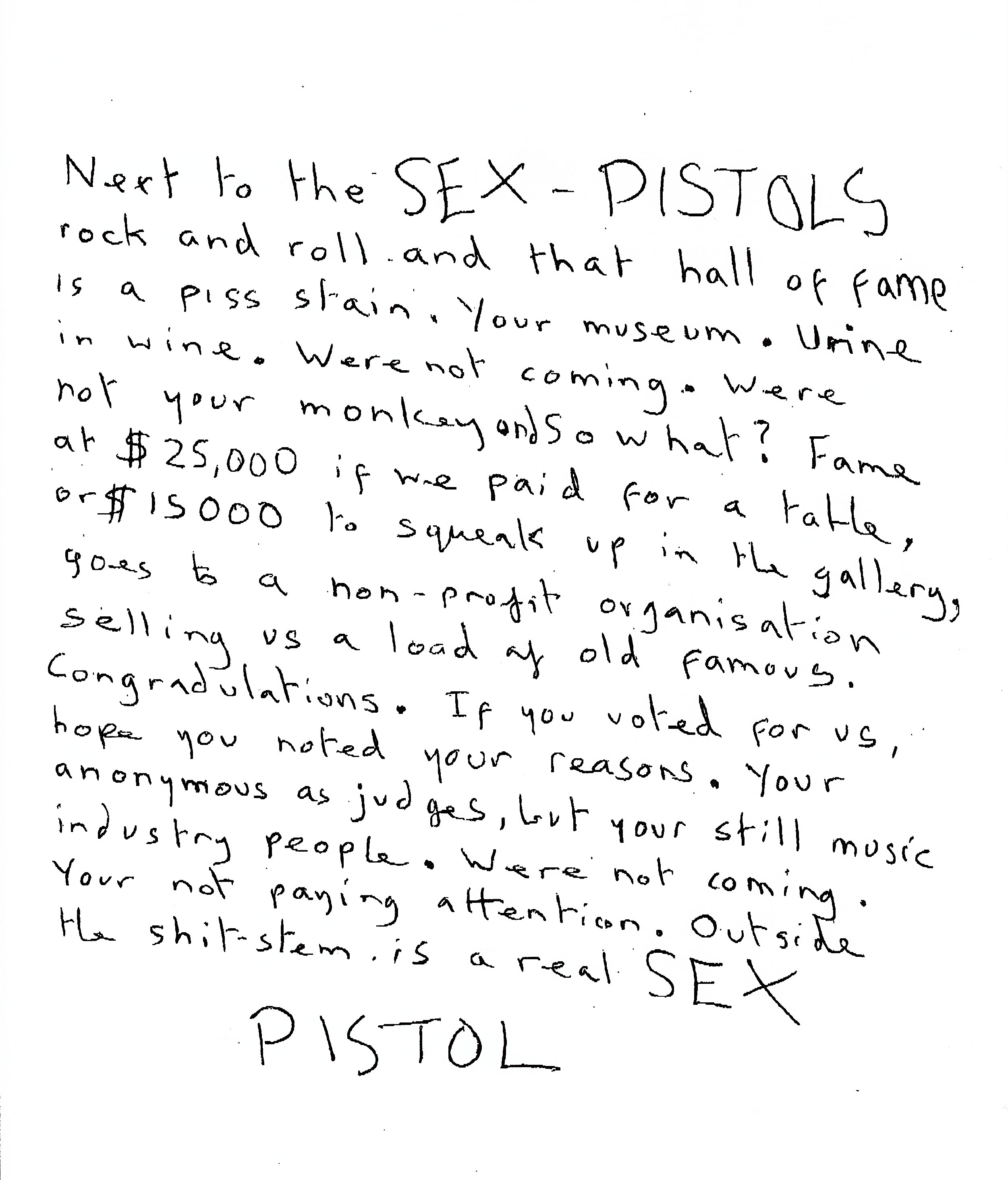
We’re Not Coming
Of course, the Sex Pistols were always about, well, the Sex Pistols, weren’t they? And the Rock ‘n’ Roll Hall of Fame is just a joke, as are most Halls of Fame, maybe all. So it’s no big surprise that Johnny Rotten and the rest of the surviving members should refuse the invitation to attend their induction. I’d have preferred better grammar, but I still think the note (which looks like it was scrawled on a cocktail napkin) is hilarious, and perfectly in character. Now, Public Image Ltd., on the other hand. . . .
Of course, the Sex Pistols were always about, well, the Sex Pistols, weren’t they? And the Rock ‘n’ Roll Hall of Fame is just a joke, as are most Halls of Fame, maybe all. So it’s no big surprise that Johnny Rotten and the rest of the surviving members should refuse the invitation to attend their induction. I’d have preferred better grammar, but I still think the note (which looks like it was scrawled on a cocktail napkin) is hilarious, and perfectly in character. Now, Public Image Ltd., on the other hand. . . .
24 February 2006
Meaning It
Just in case Australians didn’t think their country was mean enough after 10 years of Howard, his putative successor has come out swinging. So much for the “subtleties” of dog-whistle politics. Peter Costello condemns multiculturalism and claims that radicals in the Muslim community seek to impose Islamic law on Australian society, the latter charge refuted by prominent Muslims, and the former by anyone with any real understanding of multiculturalism, something Mr. Costello either lacks or suppresses in his zeal to achieve the leadership position so successfully held by the culturally divisive John Howard. This is politics at its worst, and while it would be laughable in a different climate, it’s a serious matter right now. Costello is desperate to become his party’s leader and take over the Prime Ministership for at least the last three years, and the only way he sees to manage this coup is to push the Howard line beyond even the meagre limits set by Howard himself. As a new Australian-to-be (and having taken the “test,” which consisted of naming two of my responsibilities as a citizen and two of my privileges), I’m appalled at Costello’s proposal, what amounts to establishing a second-class category of citizen, offering to strip away naturalization for anyone who fails to meet his standards. I’d agree that anyone who lies in their application should indeed see their status revoked, but there’s a point at which deportation is no longer an option, when the criminal justice system can be successfully invoked, and it’s not clear what the limit are of Costello’s proposal. It seems to be his intention to take the qualification for citizenship out well beyond the oath and into normal daily life. Multiculturalism isn’t simply a matter of “food, fashion, and religion,” as he defines it. And while the behavior of some Muslims around the world over the offensive prophet cartoons deserves condemnation and contempt, I don’t recall any riots involving Muslims in Australia other than Cronulla.
Just in case Australians didn’t think their country was mean enough after 10 years of Howard, his putative successor has come out swinging. So much for the “subtleties” of dog-whistle politics. Peter Costello condemns multiculturalism and claims that radicals in the Muslim community seek to impose Islamic law on Australian society, the latter charge refuted by prominent Muslims, and the former by anyone with any real understanding of multiculturalism, something Mr. Costello either lacks or suppresses in his zeal to achieve the leadership position so successfully held by the culturally divisive John Howard. This is politics at its worst, and while it would be laughable in a different climate, it’s a serious matter right now. Costello is desperate to become his party’s leader and take over the Prime Ministership for at least the last three years, and the only way he sees to manage this coup is to push the Howard line beyond even the meagre limits set by Howard himself. As a new Australian-to-be (and having taken the “test,” which consisted of naming two of my responsibilities as a citizen and two of my privileges), I’m appalled at Costello’s proposal, what amounts to establishing a second-class category of citizen, offering to strip away naturalization for anyone who fails to meet his standards. I’d agree that anyone who lies in their application should indeed see their status revoked, but there’s a point at which deportation is no longer an option, when the criminal justice system can be successfully invoked, and it’s not clear what the limit are of Costello’s proposal. It seems to be his intention to take the qualification for citizenship out well beyond the oath and into normal daily life. Multiculturalism isn’t simply a matter of “food, fashion, and religion,” as he defines it. And while the behavior of some Muslims around the world over the offensive prophet cartoons deserves condemnation and contempt, I don’t recall any riots involving Muslims in Australia other than Cronulla.
20 February 2006
The Action Movie Weekend
Really there was only one action movie, which I’ll get to, but the immediate attention belongs to Capote, and rightly so, since, as everyone’ll be aware by this time (including many who’ve never heard of Truman Capote, like some people I spoke to just this morning – and why be surprised? He’s an American author, and one who never wrote another novel after In Cold Blood, which is about forty years old now) the hype on this picture is all true. Leave it just to Phillip Seymour Hoffman, and it’s all true, and while he’s the best of a terrific cast, the rest of the actors put in great performances, nobody hitting a wrong note throughout. It’s a slow but well-paced film and builds its characters with all the fine attention Capote brought to bear in his great book, but even more so, since William Shawn and Harper Lee get a great deal more of a look-in than I can recall from the novel. Watching Capote’s descent into alcoholism and shame is almost traumatizing, but the movie never descends into maudlin pandering explication, leaving everything up to the subtleties of the acting.
On the other hand, and probably only because I can’t ever stay away from a space opera, let alone, these days, fail to afford Joss Whedon with the benefit of the doubt, Buffy fan that I’ve been, we had to watch Serenity, the cinema adaptation of Firefly, following the t.v. show’s cancellation. While this movie failed to capture M.’s attention within the first five minutes or to engage her sympathies with any of the characters – and I can see why – it’s still an interesting movie. Often billed as a space Western, what with all the “I aims” and “reckoning” being slung around in lazy drawls with the same panache as six guns are fast-drawn and fired, it is, I think, much more specific than that: it’s a x-century transposed Reconstruction era Western. Well, that’s obvious, since it involves a group of irregulars from the losing side still making forays into frontier territory following the conclusion of a vast, violent, and debilitating civil war, generally dissatisfied with the fate of their efforts at independence from an overbearing central government. It probably wouldn’t do to take the analogies too far, but they’re still pretty obvious and Whedon is very clearly exploring the same themes as Clint Eastwood has in The Outlaw Josey Wales, if not Unforgiven. It might have been pushing too hard for him to get into Faulkner territory, but the option for the film to head towards a franchise of sequels might still offer opportunity to range across that great American theme. Don’t hold your breath; there are excellent reasons for not going there, notably the example of late episodes of the early Star Trek the earnestness of which are still cringe-inducing. All up, though, it’s too easy to dismiss this movie for its surface violence and smaller points of improbabilities. There is a larger theme, as there was in Buffy, although it may be somewhat bigger than Whedon’s palette is capable of just yet. However, what he does do better with, although perhaps not as well as might be hoped for, is the look and feel elements, those things that made the Millenium Falcon segments of the Star Wars movies the more entertaining science fiction components therein. So characters: sketchy. Plot: big. Picture: nicely imagined. It's a B+ B-movie, and that's probably enough.
Really there was only one action movie, which I’ll get to, but the immediate attention belongs to Capote, and rightly so, since, as everyone’ll be aware by this time (including many who’ve never heard of Truman Capote, like some people I spoke to just this morning – and why be surprised? He’s an American author, and one who never wrote another novel after In Cold Blood, which is about forty years old now) the hype on this picture is all true. Leave it just to Phillip Seymour Hoffman, and it’s all true, and while he’s the best of a terrific cast, the rest of the actors put in great performances, nobody hitting a wrong note throughout. It’s a slow but well-paced film and builds its characters with all the fine attention Capote brought to bear in his great book, but even more so, since William Shawn and Harper Lee get a great deal more of a look-in than I can recall from the novel. Watching Capote’s descent into alcoholism and shame is almost traumatizing, but the movie never descends into maudlin pandering explication, leaving everything up to the subtleties of the acting.
On the other hand, and probably only because I can’t ever stay away from a space opera, let alone, these days, fail to afford Joss Whedon with the benefit of the doubt, Buffy fan that I’ve been, we had to watch Serenity, the cinema adaptation of Firefly, following the t.v. show’s cancellation. While this movie failed to capture M.’s attention within the first five minutes or to engage her sympathies with any of the characters – and I can see why – it’s still an interesting movie. Often billed as a space Western, what with all the “I aims” and “reckoning” being slung around in lazy drawls with the same panache as six guns are fast-drawn and fired, it is, I think, much more specific than that: it’s a x-century transposed Reconstruction era Western. Well, that’s obvious, since it involves a group of irregulars from the losing side still making forays into frontier territory following the conclusion of a vast, violent, and debilitating civil war, generally dissatisfied with the fate of their efforts at independence from an overbearing central government. It probably wouldn’t do to take the analogies too far, but they’re still pretty obvious and Whedon is very clearly exploring the same themes as Clint Eastwood has in The Outlaw Josey Wales, if not Unforgiven. It might have been pushing too hard for him to get into Faulkner territory, but the option for the film to head towards a franchise of sequels might still offer opportunity to range across that great American theme. Don’t hold your breath; there are excellent reasons for not going there, notably the example of late episodes of the early Star Trek the earnestness of which are still cringe-inducing. All up, though, it’s too easy to dismiss this movie for its surface violence and smaller points of improbabilities. There is a larger theme, as there was in Buffy, although it may be somewhat bigger than Whedon’s palette is capable of just yet. However, what he does do better with, although perhaps not as well as might be hoped for, is the look and feel elements, those things that made the Millenium Falcon segments of the Star Wars movies the more entertaining science fiction components therein. So characters: sketchy. Plot: big. Picture: nicely imagined. It's a B+ B-movie, and that's probably enough.
14 February 2006
Oi, Oi, Oi
Coming back up Crown Street Sunday morning, I ran into the designer of the flag represented below, a proposal to replace the traditional Aussie Union Jack design, and one that I think is a big improvement, colorful and outside the standard stripes/rectangles more usually seen. Having successfully passed my examination to become a citizen of Australia, I’ll soon get my opportunity to start throwing my vote away . . . I mean throwing my vote behind the Republican movement, and while I’m at it, perhaps behind a new flag. While the Eureka Stockade flag is nice, in a kind of retro, homemade way, it’s been too co-opted over the years by extremist right-wing groups to fly over Parliament House, and as much as I like the design of the Aboriginal flag, it doesn’t represent me, and is, in fact, designed to exclude me and any non-Aborigine. This design, on the other hand, is inclusive of native and non-native peoples, retaining the blue field and Southern Cross motif of the original “European” flag, thereby maintaining the respect and honor demanded by those who served under that banner, as well as containing an “Aboriginal” motif in the central, yellow-and-red dot “boomerang.” It’s thoughtful, a bit abstract, a bit literal, a good design overall, and would look good waving around at sporting events (perhaps the only good reason left to have a flag).

Coming back up Crown Street Sunday morning, I ran into the designer of the flag represented below, a proposal to replace the traditional Aussie Union Jack design, and one that I think is a big improvement, colorful and outside the standard stripes/rectangles more usually seen. Having successfully passed my examination to become a citizen of Australia, I’ll soon get my opportunity to start throwing my vote away . . . I mean throwing my vote behind the Republican movement, and while I’m at it, perhaps behind a new flag. While the Eureka Stockade flag is nice, in a kind of retro, homemade way, it’s been too co-opted over the years by extremist right-wing groups to fly over Parliament House, and as much as I like the design of the Aboriginal flag, it doesn’t represent me, and is, in fact, designed to exclude me and any non-Aborigine. This design, on the other hand, is inclusive of native and non-native peoples, retaining the blue field and Southern Cross motif of the original “European” flag, thereby maintaining the respect and honor demanded by those who served under that banner, as well as containing an “Aboriginal” motif in the central, yellow-and-red dot “boomerang.” It’s thoughtful, a bit abstract, a bit literal, a good design overall, and would look good waving around at sporting events (perhaps the only good reason left to have a flag).
13 February 2006
Hoo-Rah
Jarhead gets comparisons to various of the post-Vietnam antiwar movies, but most of them are too literal and so undeserved. It is an antiwar movie of its own generation. As the narrator says, every war is different. That doesn’t mean they aren’t the same, however, as is also noted. And the same is true of the films made. Jarhead is a much different movie from Three Kings or that one with Meg Ryan, Courage Under Fire, as it is from the most often (and probably most accurately, if anything can be) citied Full Metal Jacket.
Leave all that aside.
Jarhead is not just an antiwar movie. It reveals much more than the cost of war, which it does well. It reveals the anachronism of military culture, focusing on the Marines, perhaps the most anachronistic of the branches of the armed services, and in so many different ways, not least being the ground-troop focus in an era that relies so heavily on air power and the mechanized forces, but also the burdens of machismo so ingrained through the indoctrination – more psychological warfare than anything else, really, and something the Marine Corps uses to very successfully create a culture of separation from the rest of the armed forces and the society they were formed to protect – and that of being a trained warrior who never gets to exercise his skills. The latter condition remains, of course, the most poignant element of the film’s examination of military service, since everyone, eventually, must retire, resign, or otherwise find themselves separated from the unit, that operative word being of great significance. And while there is the “free speech” and “war for oil” argumentation, that’s not what the movie’s about, even in light of the current situation in Iraq, not discounting those issues. Iraq War I or Iraq War II or Vietnam or any other conflict of any size or duration, the culture of war is what’s at issue and what ends up being both the most frightening and saddest problem servicemen and women and our civilization must learn from but never seems to.
We’ll face these problems again, as the troops come home, when the war ends, and the next war ends, and the one after that. And the worst of it will be borne by the soldiers, the ones who join because they don’t know what else to do, the ones who join because they believe in what they’re going to be asked to do, the ones who join because joining is the only option they’ve got or can conceive of or just need to feel like a real person.
It’s a very affecting movie and deserves to be seen. Go see it.
Jarhead gets comparisons to various of the post-Vietnam antiwar movies, but most of them are too literal and so undeserved. It is an antiwar movie of its own generation. As the narrator says, every war is different. That doesn’t mean they aren’t the same, however, as is also noted. And the same is true of the films made. Jarhead is a much different movie from Three Kings or that one with Meg Ryan, Courage Under Fire, as it is from the most often (and probably most accurately, if anything can be) citied Full Metal Jacket.
Leave all that aside.
Jarhead is not just an antiwar movie. It reveals much more than the cost of war, which it does well. It reveals the anachronism of military culture, focusing on the Marines, perhaps the most anachronistic of the branches of the armed services, and in so many different ways, not least being the ground-troop focus in an era that relies so heavily on air power and the mechanized forces, but also the burdens of machismo so ingrained through the indoctrination – more psychological warfare than anything else, really, and something the Marine Corps uses to very successfully create a culture of separation from the rest of the armed forces and the society they were formed to protect – and that of being a trained warrior who never gets to exercise his skills. The latter condition remains, of course, the most poignant element of the film’s examination of military service, since everyone, eventually, must retire, resign, or otherwise find themselves separated from the unit, that operative word being of great significance. And while there is the “free speech” and “war for oil” argumentation, that’s not what the movie’s about, even in light of the current situation in Iraq, not discounting those issues. Iraq War I or Iraq War II or Vietnam or any other conflict of any size or duration, the culture of war is what’s at issue and what ends up being both the most frightening and saddest problem servicemen and women and our civilization must learn from but never seems to.
We’ll face these problems again, as the troops come home, when the war ends, and the next war ends, and the one after that. And the worst of it will be borne by the soldiers, the ones who join because they don’t know what else to do, the ones who join because they believe in what they’re going to be asked to do, the ones who join because joining is the only option they’ve got or can conceive of or just need to feel like a real person.
It’s a very affecting movie and deserves to be seen. Go see it.
Who's Your Daddy?
I don't know Glenn Greenwald, and I'd never have found his post on the new right-wing cult of personality ideology without Metafilter, but that's not the point. The point is, Greenwald's dead-on here, nailing these conservative so-called pundits' colors to the mast for all to see and clearly understand. I've been reading (much) lesser versions in the comments threads over at Road to Surfdom and Larvatus Prodeo, where Bush supporters weigh in regularly with violent and nearly insensible screeds in support of concentration camps and prisoner abuse and wiretaps and every other violation of national and international standards and laws regarding civil liberties and the conduct of war. And the first thing that comes to mind is that they sound like they take their marching orders from Dick Cheney and Karl Rove. (Worse, they'd be proud to accept that characterization.) There is a new conservatism in America and elsewhere that hates everyone who isn't them and fears everyone who criticizes them and wants Bush to make it better. James Wolcott calls them "bedwetters." I do, too.
I don't know Glenn Greenwald, and I'd never have found his post on the new right-wing cult of personality ideology without Metafilter, but that's not the point. The point is, Greenwald's dead-on here, nailing these conservative so-called pundits' colors to the mast for all to see and clearly understand. I've been reading (much) lesser versions in the comments threads over at Road to Surfdom and Larvatus Prodeo, where Bush supporters weigh in regularly with violent and nearly insensible screeds in support of concentration camps and prisoner abuse and wiretaps and every other violation of national and international standards and laws regarding civil liberties and the conduct of war. And the first thing that comes to mind is that they sound like they take their marching orders from Dick Cheney and Karl Rove. (Worse, they'd be proud to accept that characterization.) There is a new conservatism in America and elsewhere that hates everyone who isn't them and fears everyone who criticizes them and wants Bush to make it better. James Wolcott calls them "bedwetters." I do, too.
10 February 2006
Cat Lassie
Everybody knows Inspector Rex, right? (O.k., no; so: he’s a crime-fighting dog working with the police and smarter than all the humans in the show put together, especially the guy with the bad haircut.) Well, meet Commissioner Kitty. Really, Lawrence Block could have written this story, assuming he turned to a different class of detective story and the cat had a drinking problem.
Everybody knows Inspector Rex, right? (O.k., no; so: he’s a crime-fighting dog working with the police and smarter than all the humans in the show put together, especially the guy with the bad haircut.) Well, meet Commissioner Kitty. Really, Lawrence Block could have written this story, assuming he turned to a different class of detective story and the cat had a drinking problem.
Baracking for Reform
John McCain is the wrong guy to look up to when it comes to lobbying reform, mostly because it involves money, something he’s got trouble turning down, but you’ve got to love Barack Obama’s zeal and the Democratic Party’s proposal for an independent commission, perhaps especially since it gets up McCain’s nose. It is, however, rarely a good idea to rush through legislation, even when the need, as in this case was revealed with the Abramoff crash-and-burn, is so patently obvious. Total travel ban or partial? 60-vote requirement on “earmarks” or no vote? Whatever else happens, one thing is clear: the now-public spat between Senators McCain and Obama is just the Arizonan’s ego getting in the way of substantial work. Ever since the S&L crisis, McCain’s been trying to paint a fiduciary picture of himself, coming off more whited sepulchre than White House material most of the time.
John McCain is the wrong guy to look up to when it comes to lobbying reform, mostly because it involves money, something he’s got trouble turning down, but you’ve got to love Barack Obama’s zeal and the Democratic Party’s proposal for an independent commission, perhaps especially since it gets up McCain’s nose. It is, however, rarely a good idea to rush through legislation, even when the need, as in this case was revealed with the Abramoff crash-and-burn, is so patently obvious. Total travel ban or partial? 60-vote requirement on “earmarks” or no vote? Whatever else happens, one thing is clear: the now-public spat between Senators McCain and Obama is just the Arizonan’s ego getting in the way of substantial work. Ever since the S&L crisis, McCain’s been trying to paint a fiduciary picture of himself, coming off more whited sepulchre than White House material most of the time.
RU486 Debate
Next week the House of Representatives will vote on whether the Health Minister gets to keep his discretion over pharmaceuticals or if the Therapeutic Goods Administration can use science to decide whether a drug is safe or not. While the argument that scientists would do whatever science itself demands, that’s basically saying that they have no ethics or morals of their own, and that’s just nonsense, not to mention insulting. And while Tony Abbott says he’d review individual applications for the prescription, that, too, is nonsense, since the time necessary to bring an application would exceed that required for the use of the drug, not to mention that even if such a submission were made in time, he’d only have to “think about it” for a day in order to exceed the window of opportunity. But with the Senate already on board, perhaps this is soon to become a non-issue? About time, but a little too late, as far as how the issue has been framed in public perception. Originally, this was the “morning after pill,” and that was a far better description of its use and intention than the “abortion pill,” as it’s been allowed to become. RU486 doesn’t trigger miscarriage per se, neither does it cause an abortion, although a D&C procedure is part of the care required for persons taking the drug. What it does do is to prevent the implantation of the egg in the uterine wall. It’s little different than an IUD, such devices themselves being little different than a condom or the Pill. For Abbott, these are all the same, as they are for many fundamentalist Christians, perhaps especially Catholics up on their doctrine, but even Rome remains focussed on abortion itself, not birth control (although the larger issues have had their encyclical moments), so reproductive health largely gets to stay a private matter between doctor and patient, not a public policy debate. To me, this is not a matter of conscience, just science. Mr. Abbott, as it’s been so wittily proclaimed, can get his “rosaries off [women’s] ovaries” and let the TGA do its job.
Next week the House of Representatives will vote on whether the Health Minister gets to keep his discretion over pharmaceuticals or if the Therapeutic Goods Administration can use science to decide whether a drug is safe or not. While the argument that scientists would do whatever science itself demands, that’s basically saying that they have no ethics or morals of their own, and that’s just nonsense, not to mention insulting. And while Tony Abbott says he’d review individual applications for the prescription, that, too, is nonsense, since the time necessary to bring an application would exceed that required for the use of the drug, not to mention that even if such a submission were made in time, he’d only have to “think about it” for a day in order to exceed the window of opportunity. But with the Senate already on board, perhaps this is soon to become a non-issue? About time, but a little too late, as far as how the issue has been framed in public perception. Originally, this was the “morning after pill,” and that was a far better description of its use and intention than the “abortion pill,” as it’s been allowed to become. RU486 doesn’t trigger miscarriage per se, neither does it cause an abortion, although a D&C procedure is part of the care required for persons taking the drug. What it does do is to prevent the implantation of the egg in the uterine wall. It’s little different than an IUD, such devices themselves being little different than a condom or the Pill. For Abbott, these are all the same, as they are for many fundamentalist Christians, perhaps especially Catholics up on their doctrine, but even Rome remains focussed on abortion itself, not birth control (although the larger issues have had their encyclical moments), so reproductive health largely gets to stay a private matter between doctor and patient, not a public policy debate. To me, this is not a matter of conscience, just science. Mr. Abbott, as it’s been so wittily proclaimed, can get his “rosaries off [women’s] ovaries” and let the TGA do its job.
Who’s Fighting Terror
George Bush is claiming credit for thwarting an attack in Los Angeles in 2002, and I thank him for it, right along with thanking everyone else who was involved, like the unnamed Southeast Asian nation who actually captured and interrogated the al Qaeda operative behind the scheme. But let’s look at the mechanisms: was unrestricted electronic surveillance without warrants the key to breaking up the plot? Was it a result of information gathered in Iraq? No, it was international cooperation. Let’s keep some perspective, o.k.?
(And can somebody explain to our President that while the two words may have many of the same letters in common, “liberty” and “library” are related only insofar as there should be no infringement of one upon the other in that damned USA Patriot Act?)
George Bush is claiming credit for thwarting an attack in Los Angeles in 2002, and I thank him for it, right along with thanking everyone else who was involved, like the unnamed Southeast Asian nation who actually captured and interrogated the al Qaeda operative behind the scheme. But let’s look at the mechanisms: was unrestricted electronic surveillance without warrants the key to breaking up the plot? Was it a result of information gathered in Iraq? No, it was international cooperation. Let’s keep some perspective, o.k.?
(And can somebody explain to our President that while the two words may have many of the same letters in common, “liberty” and “library” are related only insofar as there should be no infringement of one upon the other in that damned USA Patriot Act?)
08 February 2006
Use of Force
In 2001, Congress authorized the use of force by the President in retaliating for and preventing further acts of terrorism. The resolution passed is now being used as an override to the 1978 law precluding domestic surveillance. Insofar as the NSA has used its computers to monitor thousands upon thousands of emails and other transmissions across telephone lines, it could be said that Bush’s order for them to do so was a brute force” approach, and therefore legal. That’s the best excuse I can come up with for him, not that I’m usually in that business. Nevertheless, as an American citizen, it’s my duty to support the President*, and offering stupid excuses for a man too stupid to come up with his own surely qualifies.
* Only if you’re listening to Britney Spears, of course, since it’s only convention that the “elected” leader should be accepted as President, and you still get to disagree with him and even actively oppose the stupid things he does.
In 2001, Congress authorized the use of force by the President in retaliating for and preventing further acts of terrorism. The resolution passed is now being used as an override to the 1978 law precluding domestic surveillance. Insofar as the NSA has used its computers to monitor thousands upon thousands of emails and other transmissions across telephone lines, it could be said that Bush’s order for them to do so was a brute force” approach, and therefore legal. That’s the best excuse I can come up with for him, not that I’m usually in that business. Nevertheless, as an American citizen, it’s my duty to support the President*, and offering stupid excuses for a man too stupid to come up with his own surely qualifies.
* Only if you’re listening to Britney Spears, of course, since it’s only convention that the “elected” leader should be accepted as President, and you still get to disagree with him and even actively oppose the stupid things he does.
06 February 2006
The Spam Defense
The argument in Parliament over how RU-486 should be managed in Australia is headed for the ludicrous much faster than I'd have expected, even with Health Mininster Tony Abbott laying about him with every club within reach. The idea he's presenting now, that RU-486 is female Viagra, just shows how far he'll go to maintain ministerial control over this one drug, despite all rational argument. Giving the Therapeutic Drug Admininstration oversight of RU-486 doesn't seem like any reason to believe in a sudden black market for the drug; just the opposite, in fact. While the availability of Viagra over the internet is certainly clogging up the email accounts of many people, that isn't because there's no one at a ministerial or cabinet level imposing control by fiat over a therapeutic substance scientifically judged safe and effective within the limits of its intended purpose and physician-directed utilization. Abbott's getting desperate, but it's his private ideology in operation, not politics, and certainly not medicine.
The argument in Parliament over how RU-486 should be managed in Australia is headed for the ludicrous much faster than I'd have expected, even with Health Mininster Tony Abbott laying about him with every club within reach. The idea he's presenting now, that RU-486 is female Viagra, just shows how far he'll go to maintain ministerial control over this one drug, despite all rational argument. Giving the Therapeutic Drug Admininstration oversight of RU-486 doesn't seem like any reason to believe in a sudden black market for the drug; just the opposite, in fact. While the availability of Viagra over the internet is certainly clogging up the email accounts of many people, that isn't because there's no one at a ministerial or cabinet level imposing control by fiat over a therapeutic substance scientifically judged safe and effective within the limits of its intended purpose and physician-directed utilization. Abbott's getting desperate, but it's his private ideology in operation, not politics, and certainly not medicine.
01 February 2006
Half
The AP scorecard on the State of the Union speech shows up the Bush administration for the half-truths and lies of omission it’s built on. Reduce dependence on Middle East oil, not all oil imports, not oil overall. (Yet when he refers to Iraq as a “strategic nation,” he means it’s got lots of oil. For us.) Provide health care to the poor and elderly, but only pharmaceuticals and even then miss tens of thousands, increase the number of uninsured Americans, and cut spending. Blame Congress for failing to act on proposals to save Social Security but forget to mention that no such proposal was ever actually issued in a way anyone could act on it, let alone that the ideas floated around at various sycophant-fests only addressed part of the workforce funnelling their FICA taxes into Wall Street. Progress in Iraq? Don’t mention the war. (Seriously, did he say “further decrease our troop levels”? Does he mean coalition members pulling their soldiers out? And citing what’s happened in Egypt and Palestine doesn’t inspire hope for democracy in the Middle East, which I guess is what he means when he says their democracies won’t “look like our[s].”) Katrina? Forget “stronger levees,” let alone any redevelopment money; the $85 billion is in business loans and temporary housing assistance, and the levees will only be built up as strong as they were before the hurricane. Those school programs he wants aren’t going to stop a Force-5 storm. The focus on homeland security is all wiretaps all the time and ignores FISA (although the way he puts it, it sounds like he applied for and received warrants, even though that never happened), never addresses how having 8 congresspersons in for a chat constitutes legislative oversight, and dissembles over the fact that thousands of leads forwarded by the NSA to the FBI were useless dead ends targeting entirely innocent American citizens, not “al Qaeda operatives”. The so-called No Child Left Behind act keeps turning out to be a song-and-dance number, and non-security deficit reduction is a joke with no punchline, unless you think “make the tax cuts (that benefit the rich over the poor) permanent” is funny or enjoy hearing about the billions of dollars being mishandled in Iraq, which means only that the kind of stewardship the American people might enjoy is missing, leaving the economic burden to lie more and more heavily on working people’s backs. Over 5,000 words, lots of optimism and triumphalism, stirring, surely, but empty, devoid of real meaning, because every freedom he proclaims he tramples on, every ethical principal he trumpets he violates. If the state of the Union is strong, it is so no thanks to the President.
The AP scorecard on the State of the Union speech shows up the Bush administration for the half-truths and lies of omission it’s built on. Reduce dependence on Middle East oil, not all oil imports, not oil overall. (Yet when he refers to Iraq as a “strategic nation,” he means it’s got lots of oil. For us.) Provide health care to the poor and elderly, but only pharmaceuticals and even then miss tens of thousands, increase the number of uninsured Americans, and cut spending. Blame Congress for failing to act on proposals to save Social Security but forget to mention that no such proposal was ever actually issued in a way anyone could act on it, let alone that the ideas floated around at various sycophant-fests only addressed part of the workforce funnelling their FICA taxes into Wall Street. Progress in Iraq? Don’t mention the war. (Seriously, did he say “further decrease our troop levels”? Does he mean coalition members pulling their soldiers out? And citing what’s happened in Egypt and Palestine doesn’t inspire hope for democracy in the Middle East, which I guess is what he means when he says their democracies won’t “look like our[s].”) Katrina? Forget “stronger levees,” let alone any redevelopment money; the $85 billion is in business loans and temporary housing assistance, and the levees will only be built up as strong as they were before the hurricane. Those school programs he wants aren’t going to stop a Force-5 storm. The focus on homeland security is all wiretaps all the time and ignores FISA (although the way he puts it, it sounds like he applied for and received warrants, even though that never happened), never addresses how having 8 congresspersons in for a chat constitutes legislative oversight, and dissembles over the fact that thousands of leads forwarded by the NSA to the FBI were useless dead ends targeting entirely innocent American citizens, not “al Qaeda operatives”. The so-called No Child Left Behind act keeps turning out to be a song-and-dance number, and non-security deficit reduction is a joke with no punchline, unless you think “make the tax cuts (that benefit the rich over the poor) permanent” is funny or enjoy hearing about the billions of dollars being mishandled in Iraq, which means only that the kind of stewardship the American people might enjoy is missing, leaving the economic burden to lie more and more heavily on working people’s backs. Over 5,000 words, lots of optimism and triumphalism, stirring, surely, but empty, devoid of real meaning, because every freedom he proclaims he tramples on, every ethical principal he trumpets he violates. If the state of the Union is strong, it is so no thanks to the President.
Who Knows
In the U.S. I could often get by just showing a set of credit cards to claim my identity to some officious bureaucrat, although I doubt that’d work now, especially flying, when the airlines were already getting pretty severe about photo ID before anyone flew a plane into a building, but here I’ve got to make up what’s known as 100 points of identification. Right now, no one can present 100 points with a single piece of ID unless you’re under 18. A passport is only 70 points, as is a birth certificate (although, and rightly so, a birth certificate isn’t properly identification at all, but only, as I was once told when attempting to renew a U.S. passport, proof I was born in the country, but that’s a separate story), a driver’s license is 40. Once you get to the credit cards and so forth, you’re working with 25 points apiece. While proposals are floating around for a National ID Card (interest in which was renewed following the London bombings last July, and which continues despite the recent finding that they’d have been entirely useless in preventing the attacks, something any reasonably intelligent person would already know), the points are part of the requirements of the Privacy Laws, legislation that keeps my details from being spread around too liberally, but which also cause some troublesome interference both in extraordinary circumstances and the quotidian. So while employers must exercise great care in what data they collect and store, let alone give out, and airlines couldn’t help the government figure out who any Australians were potentially caught up in the Boxing Day Tsunami, they also make sure I’ve got to front up to a teller at the bank in order to transact anything beyond the simplest on-line transaction or send original documents through the post for authentication. Such laws are even more robust elsewhere, and what Dracula’s proposing seems meant to bring Australia up the scale as well, while allowing particular loopholes for the government. In other words, more complexity for me, less for them.
In the U.S. I could often get by just showing a set of credit cards to claim my identity to some officious bureaucrat, although I doubt that’d work now, especially flying, when the airlines were already getting pretty severe about photo ID before anyone flew a plane into a building, but here I’ve got to make up what’s known as 100 points of identification. Right now, no one can present 100 points with a single piece of ID unless you’re under 18. A passport is only 70 points, as is a birth certificate (although, and rightly so, a birth certificate isn’t properly identification at all, but only, as I was once told when attempting to renew a U.S. passport, proof I was born in the country, but that’s a separate story), a driver’s license is 40. Once you get to the credit cards and so forth, you’re working with 25 points apiece. While proposals are floating around for a National ID Card (interest in which was renewed following the London bombings last July, and which continues despite the recent finding that they’d have been entirely useless in preventing the attacks, something any reasonably intelligent person would already know), the points are part of the requirements of the Privacy Laws, legislation that keeps my details from being spread around too liberally, but which also cause some troublesome interference both in extraordinary circumstances and the quotidian. So while employers must exercise great care in what data they collect and store, let alone give out, and airlines couldn’t help the government figure out who any Australians were potentially caught up in the Boxing Day Tsunami, they also make sure I’ve got to front up to a teller at the bank in order to transact anything beyond the simplest on-line transaction or send original documents through the post for authentication. Such laws are even more robust elsewhere, and what Dracula’s proposing seems meant to bring Australia up the scale as well, while allowing particular loopholes for the government. In other words, more complexity for me, less for them.
31 January 2006
If We Could See Ourselves as Others See Us
And we can. What’s remarkable – though unsurprising – is how the negatives are denied by Americans and the positives embraced, in counterpoint to the overall trend. Sure, the agreement among Americans to “America scares me” is bound to be low (although how that’s possible with today’s Senate vote on cloture giving Alito a clear path to the Supreme Court, among other things), but look at some of the other questions, like “America is a force for good in the world” or even more “America is reaping the thorns planted by its rulers in the world,” where we’re alone in the view that we’re not. Of course, nearly everyone likes our movies, and that’s something, right? (Maybe not, since most other countries don’t regard our cultural output as something to emulate.) But meanwhile, while most people around the world seem to think al Qaeda is more dangerous than America, they also tend to agree that American military strength makes the world more dangerous rather than safer.
Maybe therapy would help.
And we can. What’s remarkable – though unsurprising – is how the negatives are denied by Americans and the positives embraced, in counterpoint to the overall trend. Sure, the agreement among Americans to “America scares me” is bound to be low (although how that’s possible with today’s Senate vote on cloture giving Alito a clear path to the Supreme Court, among other things), but look at some of the other questions, like “America is a force for good in the world” or even more “America is reaping the thorns planted by its rulers in the world,” where we’re alone in the view that we’re not. Of course, nearly everyone likes our movies, and that’s something, right? (Maybe not, since most other countries don’t regard our cultural output as something to emulate.) But meanwhile, while most people around the world seem to think al Qaeda is more dangerous than America, they also tend to agree that American military strength makes the world more dangerous rather than safer.
Maybe therapy would help.
The JFK Look-Alike Caucus
Remember Bob Forehead? Funny how, more than twenty years later, we’re still dealing with the Reagan legacy. Look at ‘em. All earnest hair and serious mien. Unfortunately, with the House and Senate and the White House all dominated by the same generation of crooks and liars of a single party, there are no checks and balances worthy of the concept, particularly with Alito set to join the Supreme Court, the American system of government is going partisan in way perhaps never seen before. There’s been a lot of talk of impeachment and special prosecutors and so forth, but I don’t see it going anywhere. Why should it? While Patrick Fitzgerald is pursuing the Plame affair, even with Libby rolling, I don’t see a result worth the effort being forthcoming. And Bush? Nada. So all that’s left is consoling myself with old “Washingtoon” comics, seeing the relevance as much as ever, maybe even in the correspondence between Ken Lay and Mr. Oxboggle.
Remember Bob Forehead? Funny how, more than twenty years later, we’re still dealing with the Reagan legacy. Look at ‘em. All earnest hair and serious mien. Unfortunately, with the House and Senate and the White House all dominated by the same generation of crooks and liars of a single party, there are no checks and balances worthy of the concept, particularly with Alito set to join the Supreme Court, the American system of government is going partisan in way perhaps never seen before. There’s been a lot of talk of impeachment and special prosecutors and so forth, but I don’t see it going anywhere. Why should it? While Patrick Fitzgerald is pursuing the Plame affair, even with Libby rolling, I don’t see a result worth the effort being forthcoming. And Bush? Nada. So all that’s left is consoling myself with old “Washingtoon” comics, seeing the relevance as much as ever, maybe even in the correspondence between Ken Lay and Mr. Oxboggle.
30 January 2006
Yo’ Mama
Quite a lot of discussion on where ‘Diss’ songs originate over on Boing-Boing, where I note attributions being corrected to Old Norse, the Romans, etc. But surely if we’re tracing the line back from rap, yes, we’ll go through the dozens, but rather than Vikings or Catullus or other European white folk, we ought to find our way back to the griot tradition, a sort of poet laureate role employed by any person of status among a wide array of African societies in which the singer composes and performs paens to the worthy person, citing their family history and its significance. Because this is an oral tradition, there’d be no records of ancient practices, but it seems pretty obvious that there’d be an ancillary tradition of taking the mickey, too, both in a spirit of just plain fun but also as a more spiteful practice for when someone’s failed to pay the negotiated fee and so forth. That’s my theory, and I’m sticking with it. In fact, I’d say the Romans got it from the Egyptians who got it from the sub-Saharan Africans, and the Vikings got it from the Romans, and so on. But these chains of causation are really pretty tenuous, since I'm sure many different strands of oral history have also developed satirical versions of themselves. Who wouldn't want to make fun of the king? It even works today.
Quite a lot of discussion on where ‘Diss’ songs originate over on Boing-Boing, where I note attributions being corrected to Old Norse, the Romans, etc. But surely if we’re tracing the line back from rap, yes, we’ll go through the dozens, but rather than Vikings or Catullus or other European white folk, we ought to find our way back to the griot tradition, a sort of poet laureate role employed by any person of status among a wide array of African societies in which the singer composes and performs paens to the worthy person, citing their family history and its significance. Because this is an oral tradition, there’d be no records of ancient practices, but it seems pretty obvious that there’d be an ancillary tradition of taking the mickey, too, both in a spirit of just plain fun but also as a more spiteful practice for when someone’s failed to pay the negotiated fee and so forth. That’s my theory, and I’m sticking with it. In fact, I’d say the Romans got it from the Egyptians who got it from the sub-Saharan Africans, and the Vikings got it from the Romans, and so on. But these chains of causation are really pretty tenuous, since I'm sure many different strands of oral history have also developed satirical versions of themselves. Who wouldn't want to make fun of the king? It even works today.
4th Act
Over at the Counsellor’s, I read a reminder of the old Gatsby line that there are no second acts in America, as well as Bill’s assessment that indeed America is all second acts. Sometimes, it seems to me after this weekend’s cinema-going, there are even third and fourth acts. The Palace Verona had a preview of Walk the Line, the Johnny Cash biopic, and he’s an example of much the U.S. loves an underdog and how often they’re willing to let him have another go. Not only did Cash manage to make his big ’68 Folsom prison comeback, he did it with his personal life shortly thereafter, marrying June Carter, once he’d gotten himself off the pills, and that’s one of the best examples of success – in both the personal and professional spheres – of all time. Then, marginalized by and large musically, Cash had his third act in the 90’s with the release of a string of albums of cover songs in which he redefined iconic and lost material by other artists in a way that better expressed his own genius than nearly anything he’d ever done before. Now that this movie’s out, he’s sure to see a posthumous fourth act, and rightly so. While the critics have often focussed on the linear narrative as a flaw, I don’t see much point in doing anything else (perhaps especially since it finishes up with his marriage to June Carter). Although pretty much all of the story is well known enough to many if not most people, the lack of revelations doesn’t detract. The music works to help engage the audience with the rise and periodic falls of the man and his career, and the performances keep us engaged with the characters on a personal level that works just fine. You’re rooting for the guy all the way through, so that every time you think, that’s it, what a wash-out, Joaquim Phoenix and Reese Witherspoon pull a Cash and/or Carter number out that revs you right back up into their lives. T. Bone Burnett’s music is terrific, too, as is the overall look and feel of the picture.
Over at the Counsellor’s, I read a reminder of the old Gatsby line that there are no second acts in America, as well as Bill’s assessment that indeed America is all second acts. Sometimes, it seems to me after this weekend’s cinema-going, there are even third and fourth acts. The Palace Verona had a preview of Walk the Line, the Johnny Cash biopic, and he’s an example of much the U.S. loves an underdog and how often they’re willing to let him have another go. Not only did Cash manage to make his big ’68 Folsom prison comeback, he did it with his personal life shortly thereafter, marrying June Carter, once he’d gotten himself off the pills, and that’s one of the best examples of success – in both the personal and professional spheres – of all time. Then, marginalized by and large musically, Cash had his third act in the 90’s with the release of a string of albums of cover songs in which he redefined iconic and lost material by other artists in a way that better expressed his own genius than nearly anything he’d ever done before. Now that this movie’s out, he’s sure to see a posthumous fourth act, and rightly so. While the critics have often focussed on the linear narrative as a flaw, I don’t see much point in doing anything else (perhaps especially since it finishes up with his marriage to June Carter). Although pretty much all of the story is well known enough to many if not most people, the lack of revelations doesn’t detract. The music works to help engage the audience with the rise and periodic falls of the man and his career, and the performances keep us engaged with the characters on a personal level that works just fine. You’re rooting for the guy all the way through, so that every time you think, that’s it, what a wash-out, Joaquim Phoenix and Reese Witherspoon pull a Cash and/or Carter number out that revs you right back up into their lives. T. Bone Burnett’s music is terrific, too, as is the overall look and feel of the picture.
29 January 2006
A Man Walk into a Doctor's Office with a Parrot on His Head . . .
The idea of creating a nurse-staffed medical diagnosis hotline sounds pretty iffy. I'm sure there would be instances where the nurse would be able to say, "Take two aspirin," etc., but the reduction in ER examinations followed by treat-and-releases would, I think, be slight, and perhaps not worth the cost of setting it up and staffing it. While I'm glad enough that Health Minister Tony Abbott is trying to do something about the rising cost of health care in this country, the fact that the Liberals have pushed the country more and more into private cover has been of much more concern to me; this is, after all, where we rank-and-file members of the society take the pocket-book hit. So what's really at stake is the future of Medicare. Unless the government can find a way to continue funding it, they'll remove it, a piece at a time, and let us fund our own care, U.S.-style, and we all know what a success that's turning out to be over the long term. Also, the states have let the quality of medical care in hospitals fall, at least if we can judge by the number of stories of emergency rooms denying ambulances entry and reports of malpractice-related injury and death. From my own experience, I look at those with a jaundiced eye, but I also don't live outside a major metropolitan center, putting me at a distinct advantage in any analysis of modern health care.
The idea of creating a nurse-staffed medical diagnosis hotline sounds pretty iffy. I'm sure there would be instances where the nurse would be able to say, "Take two aspirin," etc., but the reduction in ER examinations followed by treat-and-releases would, I think, be slight, and perhaps not worth the cost of setting it up and staffing it. While I'm glad enough that Health Minister Tony Abbott is trying to do something about the rising cost of health care in this country, the fact that the Liberals have pushed the country more and more into private cover has been of much more concern to me; this is, after all, where we rank-and-file members of the society take the pocket-book hit. So what's really at stake is the future of Medicare. Unless the government can find a way to continue funding it, they'll remove it, a piece at a time, and let us fund our own care, U.S.-style, and we all know what a success that's turning out to be over the long term. Also, the states have let the quality of medical care in hospitals fall, at least if we can judge by the number of stories of emergency rooms denying ambulances entry and reports of malpractice-related injury and death. From my own experience, I look at those with a jaundiced eye, but I also don't live outside a major metropolitan center, putting me at a distinct advantage in any analysis of modern health care.
27 January 2006
Brokeback
Even after The Shipping News, I’d probably go see anything adapted from an Annie Proulx story, but right now I can’t remember if it was the original story, which I read in the New Yorker when it appeared, all the pre-release hype, or just the immediate recognition somehow that Brokeback Mountain was going to be a terrific movie, that drove us to ensure our place in the theatre for opening day by purchasing a pair of tickets days in advance. Well, all that and the fact that living as close to Oxford Street, where Sydney’s gay community tends to congregate, meant that sold-out sessions were in the cards unless we did. Even then, showing up early still left us facing a line down the block to get in.
The reviews we’ve seen have all tried to find something negative to say, but failed, ultimately. “Lingers too long on the landscape,” we’d hear, or something more or less to that effect. Sorry, no, I don’t think so at all. In that specific, for example, the vastness, the sweeping reach, oh, never mind, every shot worked with the characters, with the performances of the people, to give us something more than some drawing room version would have. And the actors were terrific. Who knew Heath Ledger had it in him to be that good? As he’s said in an interview, without the benefit of working on stage or taking acting lessons, he’s made all his learning-curve mistakes on screen, but if that’s what it takes to put on a performance like this one, it’s been worth all the Knight’s Tale’s he wants to make.
Don’t make the mistake of thinking of it as the “gay cowboy movie,” that misses everything important about it, mischaracterizes it in a demeaning fashion. (Not that there’s anything wrong with gay cowboys.) Brokeback Mountain is a heartbreaking story. Ang Lee has applied an incredibly sympathetic eye to every element of the movie, not just the characters and the story itself, but even to the 1970’s electric carving knife – hey, Dad had one of those! – used in one scene of domestic intranquillity, for example. I’d have expected it from the director of The Ice Storm and even Crouching Tiger, if not The Incredible Hulk (but maybe I underestimate what he tried to do there). Everything in the movie contributes to the story, everything breaks your heart.
Even after The Shipping News, I’d probably go see anything adapted from an Annie Proulx story, but right now I can’t remember if it was the original story, which I read in the New Yorker when it appeared, all the pre-release hype, or just the immediate recognition somehow that Brokeback Mountain was going to be a terrific movie, that drove us to ensure our place in the theatre for opening day by purchasing a pair of tickets days in advance. Well, all that and the fact that living as close to Oxford Street, where Sydney’s gay community tends to congregate, meant that sold-out sessions were in the cards unless we did. Even then, showing up early still left us facing a line down the block to get in.
The reviews we’ve seen have all tried to find something negative to say, but failed, ultimately. “Lingers too long on the landscape,” we’d hear, or something more or less to that effect. Sorry, no, I don’t think so at all. In that specific, for example, the vastness, the sweeping reach, oh, never mind, every shot worked with the characters, with the performances of the people, to give us something more than some drawing room version would have. And the actors were terrific. Who knew Heath Ledger had it in him to be that good? As he’s said in an interview, without the benefit of working on stage or taking acting lessons, he’s made all his learning-curve mistakes on screen, but if that’s what it takes to put on a performance like this one, it’s been worth all the Knight’s Tale’s he wants to make.
Don’t make the mistake of thinking of it as the “gay cowboy movie,” that misses everything important about it, mischaracterizes it in a demeaning fashion. (Not that there’s anything wrong with gay cowboys.) Brokeback Mountain is a heartbreaking story. Ang Lee has applied an incredibly sympathetic eye to every element of the movie, not just the characters and the story itself, but even to the 1970’s electric carving knife – hey, Dad had one of those! – used in one scene of domestic intranquillity, for example. I’d have expected it from the director of The Ice Storm and even Crouching Tiger, if not The Incredible Hulk (but maybe I underestimate what he tried to do there). Everything in the movie contributes to the story, everything breaks your heart.
Midterm
With Ariel Sharon out of the political picture permanently (other than in respect to his legacy, a mixed bag at best), the Palestinian elections became even more significant than they were bound to be already. The win by Hamas has probably been inevitable since Arafat’s death, if perhaps not expected to be so at such a large margin. Hamas has, over many years now, provided the social services the PLA were never able to unmire themselves from their own internecine conflicts and corruption long enough to establish, even though those were the very things needed to put “Authority” in place of “Organization.” Their control of southern Lebanon and the support of Syria made them a political contender in a way that Arafat couldn’t do for himself, for all his bravado, bluster, and Nobel Prize-winner status (the man who wore a gun to the UN? who orchestrated the ’72 Olympics massacre?), let alone with whatever small help the US ever provided. What will come from this has all the appearance of a hydra’s head: lop off Arafat and seven times worse grows from its neck, and without even the cauterizing power of a strong man in the Knesset.
With Ariel Sharon out of the political picture permanently (other than in respect to his legacy, a mixed bag at best), the Palestinian elections became even more significant than they were bound to be already. The win by Hamas has probably been inevitable since Arafat’s death, if perhaps not expected to be so at such a large margin. Hamas has, over many years now, provided the social services the PLA were never able to unmire themselves from their own internecine conflicts and corruption long enough to establish, even though those were the very things needed to put “Authority” in place of “Organization.” Their control of southern Lebanon and the support of Syria made them a political contender in a way that Arafat couldn’t do for himself, for all his bravado, bluster, and Nobel Prize-winner status (the man who wore a gun to the UN? who orchestrated the ’72 Olympics massacre?), let alone with whatever small help the US ever provided. What will come from this has all the appearance of a hydra’s head: lop off Arafat and seven times worse grows from its neck, and without even the cauterizing power of a strong man in the Knesset.
26 January 2006
Happy Australia Day
Or, as Columbus Day is known among the indigenous population back home, "Invasion Day." Today is the commemoration of the landing of the First Fleet, a fun fact I ought to commit to memory as much interview for citizenship approaches (next Friday, itself also a more personal anniversary), although luckily, I won't be required to make much of an effort, apparently, a situation at least one politician would like to remedy. Although I'll miss out on being included among this year's new citizen crop, I wasn't going to get a card from the PM anyway, let alone any other notice, since Canberra isn't my local council. Nevertheless, I understand Sydney Councils hand out tree seedlings. Much as I'd rather some basil or a tomato plant, it will be an interesting experiment when the time comes to see what my roots grow to on the balcony.
Oh, and I started the day with an 8K run, sponsored by one of those private healthcover insurance companies. I'll post the results when they do, along with any photo I can turn up - not that my results were such I'm eager to publish them, but it was the first run since we got back from Terrigal, so I'll take that as my excuse.
Or, as Columbus Day is known among the indigenous population back home, "Invasion Day." Today is the commemoration of the landing of the First Fleet, a fun fact I ought to commit to memory as much interview for citizenship approaches (next Friday, itself also a more personal anniversary), although luckily, I won't be required to make much of an effort, apparently, a situation at least one politician would like to remedy. Although I'll miss out on being included among this year's new citizen crop, I wasn't going to get a card from the PM anyway, let alone any other notice, since Canberra isn't my local council. Nevertheless, I understand Sydney Councils hand out tree seedlings. Much as I'd rather some basil or a tomato plant, it will be an interesting experiment when the time comes to see what my roots grow to on the balcony.
Oh, and I started the day with an 8K run, sponsored by one of those private healthcover insurance companies. I'll post the results when they do, along with any photo I can turn up - not that my results were such I'm eager to publish them, but it was the first run since we got back from Terrigal, so I'll take that as my excuse.
25 January 2006
Up or Down
After invalidating their own whinging claim regarding the entitlement of judicial nominees to an “up or down vote” by forwarding an unqualified candidate for review to the Supreme Court, subsequently withdrawn, the GOP-dominated Judiciary Committee has now sent the latest Bush ideologue to the full Senate with approval split 10-8 on party lines. As Howard Dean has said, Alito must be rejected. He approves of the Bush violations to the checks-and-balances system established 200 years ago that has worked so well all this time, as well as being a fundamentalist zealot who believes in legislating morality even when the issue at question may be simply medical. With him and Roberts in the Nine, we’ve only got Kennedy to rely upon for nuanced and thoughtful votes, many of which we can expect on a court so constituted to end up as dissents only. If any of the Republican legislators had the true courage of their self-touted “moral values,” the vote on Alito might have gone the other way, and it still might, when the remaining 82 vote. I doubt the utility of a filibuster on this, except as a way to let the Repugnants eliminate the option, but I still hope for a strong fight from Senator Reid and his colleagues.
After invalidating their own whinging claim regarding the entitlement of judicial nominees to an “up or down vote” by forwarding an unqualified candidate for review to the Supreme Court, subsequently withdrawn, the GOP-dominated Judiciary Committee has now sent the latest Bush ideologue to the full Senate with approval split 10-8 on party lines. As Howard Dean has said, Alito must be rejected. He approves of the Bush violations to the checks-and-balances system established 200 years ago that has worked so well all this time, as well as being a fundamentalist zealot who believes in legislating morality even when the issue at question may be simply medical. With him and Roberts in the Nine, we’ve only got Kennedy to rely upon for nuanced and thoughtful votes, many of which we can expect on a court so constituted to end up as dissents only. If any of the Republican legislators had the true courage of their self-touted “moral values,” the vote on Alito might have gone the other way, and it still might, when the remaining 82 vote. I doubt the utility of a filibuster on this, except as a way to let the Repugnants eliminate the option, but I still hope for a strong fight from Senator Reid and his colleagues.
23 January 2006
Tax Cuts
Abolishing the 15% tax on superannuation make sense to me. “Super,” as its called, is the primary retirement fund mechanism for working Australians, and consists of an annualized 9% of salary paid by employers into specially-designated mutual funds. This contribution towards employees’ retirement is treated as part of their “total compensation,” much the way health and welfare benefits are in the U.S., although, under normal “permanent” employment conditions, it’s compulsory. Of course, that’s the idea behind “total compensation” – that employees aren’t simply paid a wage, they cost their employers much more, and those costs, too, are part of what an employee is “worth.” Fair enough, I suppose, to an extent, and in the case of superannuation – unlike the U.S. 401(k) programs, where I’m contributing pre-tax funds matched in part as a benefit by my employer – it’s free money to me for when I’m old enough to make that “sea change,” only costing me that 15%. That’s if I’m not misunderstanding the tax at issue. It’s possible, reading this article, that the 15% is being levied annually against the funds themselves. Since I’m also paying exorbitant administrative fees – me, mind you, not my employer (and again, fair enough), an additional 15% to the government just so I can have retirement funds is 15% more than I’m willing to pay. Tax me when I retire, if it comes to that, not before, so the funds have a chance to develop into something I actually can retire on.
Abolishing the 15% tax on superannuation make sense to me. “Super,” as its called, is the primary retirement fund mechanism for working Australians, and consists of an annualized 9% of salary paid by employers into specially-designated mutual funds. This contribution towards employees’ retirement is treated as part of their “total compensation,” much the way health and welfare benefits are in the U.S., although, under normal “permanent” employment conditions, it’s compulsory. Of course, that’s the idea behind “total compensation” – that employees aren’t simply paid a wage, they cost their employers much more, and those costs, too, are part of what an employee is “worth.” Fair enough, I suppose, to an extent, and in the case of superannuation – unlike the U.S. 401(k) programs, where I’m contributing pre-tax funds matched in part as a benefit by my employer – it’s free money to me for when I’m old enough to make that “sea change,” only costing me that 15%. That’s if I’m not misunderstanding the tax at issue. It’s possible, reading this article, that the 15% is being levied annually against the funds themselves. Since I’m also paying exorbitant administrative fees – me, mind you, not my employer (and again, fair enough), an additional 15% to the government just so I can have retirement funds is 15% more than I’m willing to pay. Tax me when I retire, if it comes to that, not before, so the funds have a chance to develop into something I actually can retire on.
20 January 2006
Rogue State
When Will Ferrell did his version of the GWB “axis of evil” speech, I was incapacitated with laughter. “You know who else is in the Axis of Evil? France. How do you like that, France?” Guess what? Well, really, France has long been a member of the nuclear club, and one of the more active ones, too, regularly irradiating Pacific atolls explosively. Like the great hero of the West, George II, Chirac has decided to make his country’s position clear: if you screw with our oil supplies, we will nuke you. (Will Ferrell also had Bush include Cheney in the “axis,” but there’s no hope of France doing the same.)
When Will Ferrell did his version of the GWB “axis of evil” speech, I was incapacitated with laughter. “You know who else is in the Axis of Evil? France. How do you like that, France?” Guess what? Well, really, France has long been a member of the nuclear club, and one of the more active ones, too, regularly irradiating Pacific atolls explosively. Like the great hero of the West, George II, Chirac has decided to make his country’s position clear: if you screw with our oil supplies, we will nuke you. (Will Ferrell also had Bush include Cheney in the “axis,” but there’s no hope of France doing the same.)
19 January 2006
Resolution
Google Earth is pretty fun, all things considered, and the other day a friend sent a snapshot with our apartment block tagged, leading me to spend a little time on-line, working out from the satellite image not only where home is, but also the office, scrolling along an arm of the harbour as it becomes the Parramatta River until I located the park where I run during lunch. The image below is just a screenshot, so it won't zoom in, but you might use the coordinates and scroll around yourself, if you're that interested.

Google Earth is pretty fun, all things considered, and the other day a friend sent a snapshot with our apartment block tagged, leading me to spend a little time on-line, working out from the satellite image not only where home is, but also the office, scrolling along an arm of the harbour as it becomes the Parramatta River until I located the park where I run during lunch. The image below is just a screenshot, so it won't zoom in, but you might use the coordinates and scroll around yourself, if you're that interested.
Women & God
How Julia Bard became the pundit of all things feminist and religious for the Sydney Morning Herald escapes me, especially whenever I read her latest thoughts on either, let alone both. Is she married to someone there or related to some high-ranking clergy[person]? Apparently, feminism isn’t just responsible for abortion, but gay marriage, censorship, and atheism, not to mention, well, feminism. (And I think she means “apocalyptic” not “apocryphal” when she quotes Manning Clark, but given the rest of her thesis, I may be wrong.) Even worse, those feminists who ran screaming from church are also responsible for the patriarchal politicians embracing the patriarchal power structures left behind, as if that hadn’t already been a power relationship well-entrenched and part of what so many over the last 50 years and more have rejected. I’ll give Ms (Miss? Mrs?) Baird one thing: at least she’s trying to think and not an Ann Coulter wannabe like Miranda Devine.
How Julia Bard became the pundit of all things feminist and religious for the Sydney Morning Herald escapes me, especially whenever I read her latest thoughts on either, let alone both. Is she married to someone there or related to some high-ranking clergy[person]? Apparently, feminism isn’t just responsible for abortion, but gay marriage, censorship, and atheism, not to mention, well, feminism. (And I think she means “apocalyptic” not “apocryphal” when she quotes Manning Clark, but given the rest of her thesis, I may be wrong.) Even worse, those feminists who ran screaming from church are also responsible for the patriarchal politicians embracing the patriarchal power structures left behind, as if that hadn’t already been a power relationship well-entrenched and part of what so many over the last 50 years and more have rejected. I’ll give Ms (Miss? Mrs?) Baird one thing: at least she’s trying to think and not an Ann Coulter wannabe like Miranda Devine.
17 January 2006
Beachiness
4 nights on the Central Coast, just steps away from the beach (although a deal further from the patrolled section), was everything it ought to be, except longer. Our hotel looked out over the Terrigal Council Lagoon – a semi-artificial body of water where we did a bit of paddling about (but no swimming, because it’s full of rain water runoff after its initial annual refill by the Council, who open a channel to the sea and let the tide do its work, then backfill it until next year) – and a little close to the road, which was not really a problem. We ate well enough, too, at the various restaurants around town, although, opting for a pizza-delivery one night proved to be disappointing. The Break offers “gourmet” pizzas, which they’ve defined as meaning small and expensive. Look, I hate to break it to you, but “gourmet” is defined by the ingredients, their variety if not their quality, and not by quantity. When I lay out $20 for a pizza, I expect at least a 12-inch circumference, not 7. Even 10 would have been o.k., so when M. asked how large a Large is, you might have said something other than “6 slices,” especially since what you sent was only divided in quarters anyway. At least the salad had macadamia nuts. It was fun calling them back and explaining all that to them, although they offered nothing else in satisfaction and we ended up going down to the restaurant attached to the Clan hotel to pick up a bit extra. The Haven provided the best meal of the trip, and I was very pleased with their vegetarian menu, something none of the other restaurants – all naturally enough focussed on seafood – thought to provide other than the usual risottos and pastas. (They also handed me a sub rosa bottle of wine, not having gotten their license yet since reopening a few weeks ago. How that works is a mystery, but I won’t question it.)
The weather wasn’t brilliant, with only Saturday offering the kind of sunshine one requires of a beach holiday, but it only really rained heavily the one day, so while our tans may not be what they might otherwise, since we practice “Slip, Slap, Slop” (slip on a shirt, slap on a hat, slop on some sunscreen, as the jingle goes), we weren’t going to be terrifically browned to begin with.
Of course, not having a car means that we only saw as much of the Central Coast as is visible from the beach or the top of the “Skillion,” a local promontory, except for the first day I went jogging and ended up somehow 10-12 kilometres further from home than I’d anticipated, my sense of direction leading me ever further from the beach (and south) than I’d meant to go, so I got to see Bateau Bay and Forrester’s Beach from the top of the highest coastal hill in the area, but was fully sore for the next two days, having done something approaching a half marathon – not all at a run, of course, since I’m not even ready for a half a half a marathon – by the time I made it back to the hotel, three hours past what I’d planned for or what M. could endure before wondering where to start calling and how to describe me in order to determine what hospital or morgue she’d have to visit.
The train to and from Gosford was quick and the bus rides not too trying, although passing through retirement communities did leave us subject to many little old ladies and men counting out their exact change fares, pre-calculated at pre-fare increase prices, sometimes causing some consternation and usually no little fumbling for change purses for the extra thirty cents. I consoled myself with the knowledge that someday I will be the one doing the fumbling and tripping over my own cane.
The return to Sydney proved humid beyond endurance after the gentle zephyrs of the coast, but we’re resolved not to fail in having another vacation before another four years have passed.


4 nights on the Central Coast, just steps away from the beach (although a deal further from the patrolled section), was everything it ought to be, except longer. Our hotel looked out over the Terrigal Council Lagoon – a semi-artificial body of water where we did a bit of paddling about (but no swimming, because it’s full of rain water runoff after its initial annual refill by the Council, who open a channel to the sea and let the tide do its work, then backfill it until next year) – and a little close to the road, which was not really a problem. We ate well enough, too, at the various restaurants around town, although, opting for a pizza-delivery one night proved to be disappointing. The Break offers “gourmet” pizzas, which they’ve defined as meaning small and expensive. Look, I hate to break it to you, but “gourmet” is defined by the ingredients, their variety if not their quality, and not by quantity. When I lay out $20 for a pizza, I expect at least a 12-inch circumference, not 7. Even 10 would have been o.k., so when M. asked how large a Large is, you might have said something other than “6 slices,” especially since what you sent was only divided in quarters anyway. At least the salad had macadamia nuts. It was fun calling them back and explaining all that to them, although they offered nothing else in satisfaction and we ended up going down to the restaurant attached to the Clan hotel to pick up a bit extra. The Haven provided the best meal of the trip, and I was very pleased with their vegetarian menu, something none of the other restaurants – all naturally enough focussed on seafood – thought to provide other than the usual risottos and pastas. (They also handed me a sub rosa bottle of wine, not having gotten their license yet since reopening a few weeks ago. How that works is a mystery, but I won’t question it.)
The weather wasn’t brilliant, with only Saturday offering the kind of sunshine one requires of a beach holiday, but it only really rained heavily the one day, so while our tans may not be what they might otherwise, since we practice “Slip, Slap, Slop” (slip on a shirt, slap on a hat, slop on some sunscreen, as the jingle goes), we weren’t going to be terrifically browned to begin with.
Of course, not having a car means that we only saw as much of the Central Coast as is visible from the beach or the top of the “Skillion,” a local promontory, except for the first day I went jogging and ended up somehow 10-12 kilometres further from home than I’d anticipated, my sense of direction leading me ever further from the beach (and south) than I’d meant to go, so I got to see Bateau Bay and Forrester’s Beach from the top of the highest coastal hill in the area, but was fully sore for the next two days, having done something approaching a half marathon – not all at a run, of course, since I’m not even ready for a half a half a marathon – by the time I made it back to the hotel, three hours past what I’d planned for or what M. could endure before wondering where to start calling and how to describe me in order to determine what hospital or morgue she’d have to visit.
The train to and from Gosford was quick and the bus rides not too trying, although passing through retirement communities did leave us subject to many little old ladies and men counting out their exact change fares, pre-calculated at pre-fare increase prices, sometimes causing some consternation and usually no little fumbling for change purses for the extra thirty cents. I consoled myself with the knowledge that someday I will be the one doing the fumbling and tripping over my own cane.
The return to Sydney proved humid beyond endurance after the gentle zephyrs of the coast, but we’re resolved not to fail in having another vacation before another four years have passed.
11 January 2006
Summertime
Now that we all know that last year was the hottest overall on record, and with this year starting off with a record temperature bang, we’re off to fabulous Terrigal for a quick holiday. As happy as I’d be to simply lie around the beach, there are various sights worth a look, including the lagoon and the Skillion, a bit of headland so named for its shape, resembling a sloping roof with no ridge or peak. Everybody says, oh, yes, don’t forget to go look at the Skillion. So we will, and then lie around on the beach until it’s time for a swim.
Meanwhile, if you need something to read on the web, I suggest Alien Loves Predator
Update: There's a lot of !!!! over sharks the past few days, as a result of a swimmer being killed up in Queensland, but sightings 50 metres from swimmers don't constitute "close" in my mind (and one of the four reported was cited in another paper as being 100 metres away), being more than half a football field (gridiron, American football) in distance. Admittedly, if the fish decides to pick me out, even from that distance he's going to get me before I even know he's there, let alone can swim to shore. But while my post-Jaws instinct is to chant, Cowardly Lion-style, "I do believe in sharks, I do, I do, I do," instead my mantra will be "I do believe in nets."
Now that we all know that last year was the hottest overall on record, and with this year starting off with a record temperature bang, we’re off to fabulous Terrigal for a quick holiday. As happy as I’d be to simply lie around the beach, there are various sights worth a look, including the lagoon and the Skillion, a bit of headland so named for its shape, resembling a sloping roof with no ridge or peak. Everybody says, oh, yes, don’t forget to go look at the Skillion. So we will, and then lie around on the beach until it’s time for a swim.
Meanwhile, if you need something to read on the web, I suggest Alien Loves Predator
Update: There's a lot of !!!! over sharks the past few days, as a result of a swimmer being killed up in Queensland, but sightings 50 metres from swimmers don't constitute "close" in my mind (and one of the four reported was cited in another paper as being 100 metres away), being more than half a football field (gridiron, American football) in distance. Admittedly, if the fish decides to pick me out, even from that distance he's going to get me before I even know he's there, let alone can swim to shore. But while my post-Jaws instinct is to chant, Cowardly Lion-style, "I do believe in sharks, I do, I do, I do," instead my mantra will be "I do believe in nets."
05 January 2006
Free Trade Isn’t
The free trade agreement reached between the U.S. and Australia last year was widely touted as a bad deal, although a lot of the noise, coming as it did from celebrities, focussed on the devastation expected to film and television in this country, something pretty well effectively accomplished long before, at least if you’ve ever watched any of the shows on offer from the three broadcast networks or gone to a multiplex cinema. It turns out to have been worse than that, with imports up and exports down. So Mark Vaile, deputy PM and chief trade negotiator is going to work on selling sugar to America at the expense of access to generic drugs. But don’t worry too much about it: the U.S. is tremendously protective of its sugar producers, famously keeping the trade embargo against Cuba on behalf of cane growers (what, you thought it was about the cigars?), so Vaile will be free to sell out to Big-Pharma without a bad conscience, but with the satisfaction of whacking National Party whipping boy Barnaby Joyce over the nose for ever speaking up. How’s the sugar crop in Brazil?
The free trade agreement reached between the U.S. and Australia last year was widely touted as a bad deal, although a lot of the noise, coming as it did from celebrities, focussed on the devastation expected to film and television in this country, something pretty well effectively accomplished long before, at least if you’ve ever watched any of the shows on offer from the three broadcast networks or gone to a multiplex cinema. It turns out to have been worse than that, with imports up and exports down. So Mark Vaile, deputy PM and chief trade negotiator is going to work on selling sugar to America at the expense of access to generic drugs. But don’t worry too much about it: the U.S. is tremendously protective of its sugar producers, famously keeping the trade embargo against Cuba on behalf of cane growers (what, you thought it was about the cigars?), so Vaile will be free to sell out to Big-Pharma without a bad conscience, but with the satisfaction of whacking National Party whipping boy Barnaby Joyce over the nose for ever speaking up. How’s the sugar crop in Brazil?
04 January 2006
Sold Out
Remember John McCain’s principled bill against torture and abuse of prisoners? He had to fight Cheney tooth and nail, but won against the White House in the end, didn’t he? Except every (uninformed) Democrats’ fantasy of the savior of the GOP sold out all prisoners in Guantanamo in exchange for avoiding Bush’s veto. It’s unclear from the news report if this is only the existing set of prisoners or all future “illegal combatants” sent to Cuba, but for a man who experienced the depredations of the North Vietnamese, this would be a surprising and disappointing concession.
Remember John McCain’s principled bill against torture and abuse of prisoners? He had to fight Cheney tooth and nail, but won against the White House in the end, didn’t he? Except every (uninformed) Democrats’ fantasy of the savior of the GOP sold out all prisoners in Guantanamo in exchange for avoiding Bush’s veto. It’s unclear from the news report if this is only the existing set of prisoners or all future “illegal combatants” sent to Cuba, but for a man who experienced the depredations of the North Vietnamese, this would be a surprising and disappointing concession.
03 January 2006
The Fire Every Time
The bushfires started early this year but seemed to stop well before Christmas, leading me to foolishly believe that we might have the holidays without any big outbreaks. Instead, we’ve got extreme conditions, big fires up in the Central Coast, and even record temperatures - 44° in the city for New Year’s Day, higher by far than any previously recorded.
The dry conditions of Australia naturally give rise to fires, although surely the numbers deliberately (or even just stupidly) set could bring significant relief. Nobody’s burning off great swathes of grassland just to hunt kangaroos anymore, so other than lightning strikes, it seems most fires are the result of arson, which I wouldn’t limit by excluding idiots tossing their cigarette butts around. (I remember reading a 19050’s Ross MacDonald detective story featuring his hardboiled successor to Raymond Chandler’s Phillip Marlowe, Lew Archer, where he drives a client up through the summer hill country and has to stop the car to stamp out her carelessly tossed cigarette, making quite a point of the nearly sociopathic nature of the thoughtless gesture. This impressed me greatly at the time, not least for the environmental awareness it evidences as a significant part of Californian public conciousness.)
Last year or the year before or the year before that, back in Arizona or New Mexico, there were cases of wildfires set by seasonal firefighters looking to get a little extra work, and while I can’t recall any such incidents here, there are enough other instances of kids and adults deliberately setting fires, more often than not never to be caught out. Unless they are, they can do it again, and we’re left unable to understand their motivation and work to prevent future occurrences, which is, of course, one of the things we need to do.
The Rural Fire Services do a magnificent job under highly dangerous conditions, suffering injury and even death, such as the ambulance driver last week, but it shouldn’t come to this, despite years-long droughts. Maliciousness and ignorance need more than a few public service television ads to be defeated.
Update: Turns out there are known arsonists, all under surveillance by police. Good, but are they arsonists, or bushfire arsonists, because I'll bet there's a difference.
The bushfires started early this year but seemed to stop well before Christmas, leading me to foolishly believe that we might have the holidays without any big outbreaks. Instead, we’ve got extreme conditions, big fires up in the Central Coast, and even record temperatures - 44° in the city for New Year’s Day, higher by far than any previously recorded.
The dry conditions of Australia naturally give rise to fires, although surely the numbers deliberately (or even just stupidly) set could bring significant relief. Nobody’s burning off great swathes of grassland just to hunt kangaroos anymore, so other than lightning strikes, it seems most fires are the result of arson, which I wouldn’t limit by excluding idiots tossing their cigarette butts around. (I remember reading a 19050’s Ross MacDonald detective story featuring his hardboiled successor to Raymond Chandler’s Phillip Marlowe, Lew Archer, where he drives a client up through the summer hill country and has to stop the car to stamp out her carelessly tossed cigarette, making quite a point of the nearly sociopathic nature of the thoughtless gesture. This impressed me greatly at the time, not least for the environmental awareness it evidences as a significant part of Californian public conciousness.)
Last year or the year before or the year before that, back in Arizona or New Mexico, there were cases of wildfires set by seasonal firefighters looking to get a little extra work, and while I can’t recall any such incidents here, there are enough other instances of kids and adults deliberately setting fires, more often than not never to be caught out. Unless they are, they can do it again, and we’re left unable to understand their motivation and work to prevent future occurrences, which is, of course, one of the things we need to do.
The Rural Fire Services do a magnificent job under highly dangerous conditions, suffering injury and even death, such as the ambulance driver last week, but it shouldn’t come to this, despite years-long droughts. Maliciousness and ignorance need more than a few public service television ads to be defeated.
Update: Turns out there are known arsonists, all under surveillance by police. Good, but are they arsonists, or bushfire arsonists, because I'll bet there's a difference.
More Movies
We hit Broken Flowers over the last weekend before I returned to work, because other than Brokeback Mountain, it’s about the top movie of the season we wanted to see (and Brokeback doesn’t open until Australia Day). I’ll pretty much see anything Bill Murray’s in these days, but maybe his understated acting set within the understated context of a Jim Jarmusch film is pushing things. We enjoyed it, sure, but most of what I enjoyed had little enough to do with the plot or the performances as such. The places he travels all look like parts of America I’ve spent a lot of time in, i.e., upstate New York (which isn’t itself a bad thing, just familiar and a little nostalgia-provoking and therefore a bit of a distraction; it would have been that anyway), and the music on the soundtrack is terrific, and the camera-work is excellent, but in the end, the movie’s main accomplishment, I think, is to leave you feeling the emptiness of the character as an emptiness of your own.
We hit Broken Flowers over the last weekend before I returned to work, because other than Brokeback Mountain, it’s about the top movie of the season we wanted to see (and Brokeback doesn’t open until Australia Day). I’ll pretty much see anything Bill Murray’s in these days, but maybe his understated acting set within the understated context of a Jim Jarmusch film is pushing things. We enjoyed it, sure, but most of what I enjoyed had little enough to do with the plot or the performances as such. The places he travels all look like parts of America I’ve spent a lot of time in, i.e., upstate New York (which isn’t itself a bad thing, just familiar and a little nostalgia-provoking and therefore a bit of a distraction; it would have been that anyway), and the music on the soundtrack is terrific, and the camera-work is excellent, but in the end, the movie’s main accomplishment, I think, is to leave you feeling the emptiness of the character as an emptiness of your own.
01 January 2006
Note to Self: 2006
Happy New Year, any and all who might venture here now and then. M., back from the hospital last Thursday, and I spent the evening watching a minor entry in the Billy Elliot school of Britsh film, Millions; cute enough, I suppose (and I rather liked the whole visitation by saints motif), but so thoroughly unfeasible as to rather deflate the thing in the end. Once it finished, we headed off the bed and slept through the fireworks and other moments of revelry in order to be revitalized for today's 40+ heat. The air conditioning is making a mockery of any other devotion we have toward reducing greenhouse gas emissions.
Before the heat hit, I managed a quick trip out to Coogee for a dip in the ocean. It'd be a shame not to indulge our easy access to the beaches before the end of the year, and since M.'s responding well to the antibiotics, I took advantage of the weather for a bit of refreshment in the Tasman. The water was very warm, but diving down a little you could reach cooler temperatures, although immediately upon exiting the water, the sun would bake it right out of you.
This is a difficult time of year for a variety of reasons, not least being that the entire country appears to go on holidays, which is especially frustrating for M., since she'll have to get some tests done, and all the doctors are away. Some may be back on Tuesday, but it's possible it'll be another week yet before they'll actually be doing anything more than making appointments. Of course, the tests must wait on the complete cessation of the inflammation that was the immediate cause of her distress last week, and even with the antibiotics having successfully removed the infectous agents causing the inflammation, it will itself take its own time to reduce. Nevertheless, it's very hard to be patient under the circumstances, although M. is bearing up surprisingly well for all that.
And thus we enter the new year, trying to remember to write '06 on cheques and correspondence and so forth and mainly looking forward to medical interventions more so than anything else, at least initially. But once we've got those out of the way, who knows? This may yet turn out to be a very good new year.
Happy New Year, any and all who might venture here now and then. M., back from the hospital last Thursday, and I spent the evening watching a minor entry in the Billy Elliot school of Britsh film, Millions; cute enough, I suppose (and I rather liked the whole visitation by saints motif), but so thoroughly unfeasible as to rather deflate the thing in the end. Once it finished, we headed off the bed and slept through the fireworks and other moments of revelry in order to be revitalized for today's 40+ heat. The air conditioning is making a mockery of any other devotion we have toward reducing greenhouse gas emissions.
Before the heat hit, I managed a quick trip out to Coogee for a dip in the ocean. It'd be a shame not to indulge our easy access to the beaches before the end of the year, and since M.'s responding well to the antibiotics, I took advantage of the weather for a bit of refreshment in the Tasman. The water was very warm, but diving down a little you could reach cooler temperatures, although immediately upon exiting the water, the sun would bake it right out of you.
This is a difficult time of year for a variety of reasons, not least being that the entire country appears to go on holidays, which is especially frustrating for M., since she'll have to get some tests done, and all the doctors are away. Some may be back on Tuesday, but it's possible it'll be another week yet before they'll actually be doing anything more than making appointments. Of course, the tests must wait on the complete cessation of the inflammation that was the immediate cause of her distress last week, and even with the antibiotics having successfully removed the infectous agents causing the inflammation, it will itself take its own time to reduce. Nevertheless, it's very hard to be patient under the circumstances, although M. is bearing up surprisingly well for all that.
And thus we enter the new year, trying to remember to write '06 on cheques and correspondence and so forth and mainly looking forward to medical interventions more so than anything else, at least initially. But once we've got those out of the way, who knows? This may yet turn out to be a very good new year.
Subscribe to:
Posts (Atom)