2008
We watched the first episode of Commander in Chief last night, and it was hilarious. (Yes, some would say “Hillaryous,” but they’re trolls.) Donald Sutherland was terrific. Of course, the back story is just silly: a Republican picking a female running mate, for example, let alone one who isn’t also a Republican, and then winning office? Never happen. Even if it did, it could only happen with the support of the party, so a line-of-succession revolt seems a bit of a stretch, at least not without a backroom deal to ensure Geena Davis never took the reins or wouldn’t get the nomination down the line. (Probably they’d have to kill her, but, hey, we’re talking about Republicans, right?) Still, the rest of the show was good; certainly the First Lady gags with her husband had me nearly incapacitated with laughter. I recall this is a cable-only show back in the U.S., which is too bad. More Americans could probably do with a little mass media exposure to a woman President in advance of the 2008 elections.
27 February 2006
Faster Than I Expected
WorkChoices is working, as reported by the Blogger on the Cast Iron Balcony. Of course it was going to happen, and I'd even seen the signs in that there was an increase in Human Resources jobs being advertised, all specifying a requirement for candidates to have industrial relations expertise, which is quite distinct from the more usual qualification of "employment relations." Still, the instance cited is mind-blowing in scale and, as noted, chuztpah. Of course, John Howard will never have to face what he's accomplished, since his next move would be into retirement. Can we put Kevin Andrews on the street soon, though? I've got an AWA I'd like him to sign.
WorkChoices is working, as reported by the Blogger on the Cast Iron Balcony. Of course it was going to happen, and I'd even seen the signs in that there was an increase in Human Resources jobs being advertised, all specifying a requirement for candidates to have industrial relations expertise, which is quite distinct from the more usual qualification of "employment relations." Still, the instance cited is mind-blowing in scale and, as noted, chuztpah. Of course, John Howard will never have to face what he's accomplished, since his next move would be into retirement. Can we put Kevin Andrews on the street soon, though? I've got an AWA I'd like him to sign.
We’re Not Coming
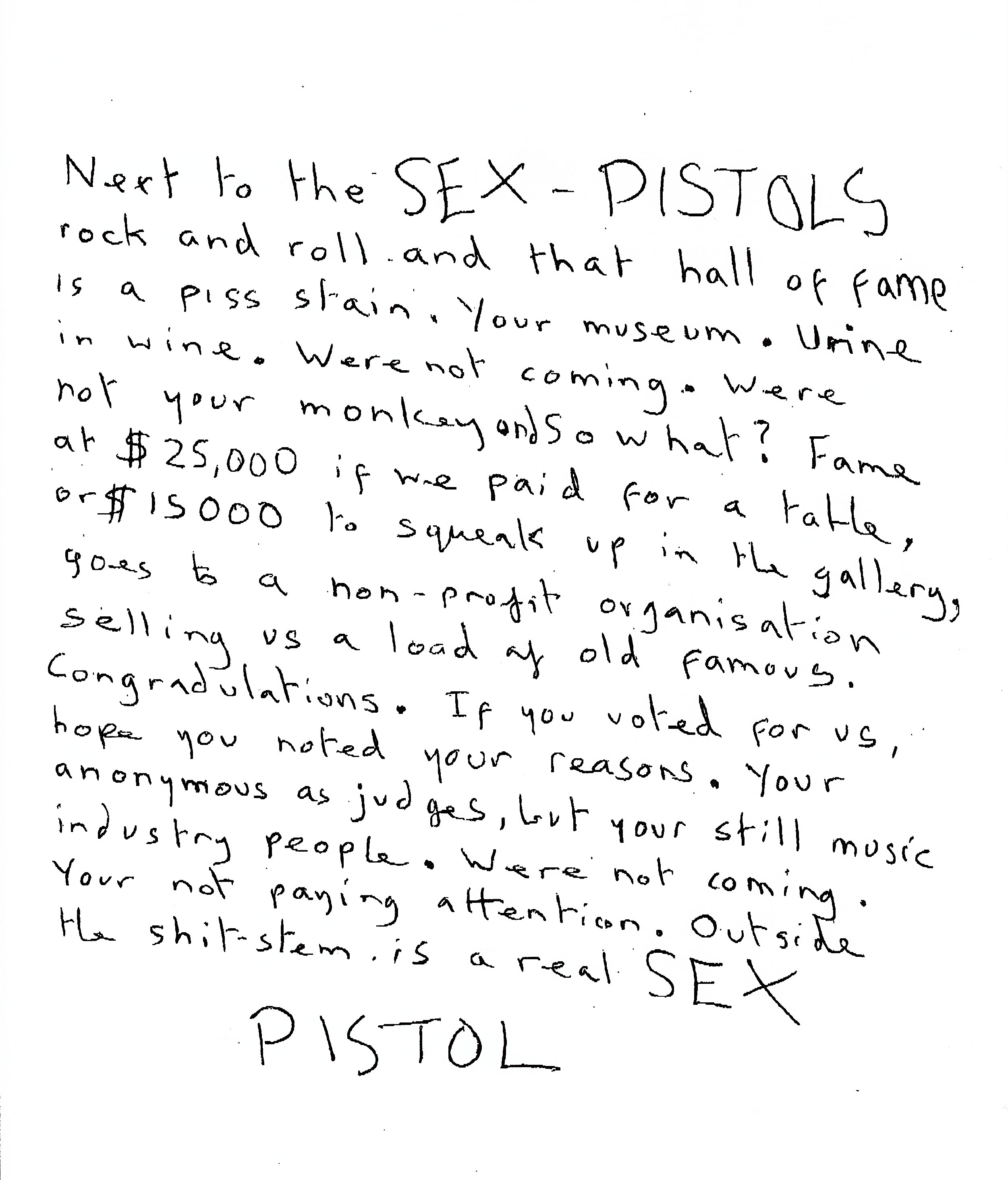
Of course, the Sex Pistols were always about, well, the Sex Pistols, weren’t they? And the Rock ‘n’ Roll Hall of Fame is just a joke, as are most Halls of Fame, maybe all. So it’s no big surprise that Johnny Rotten and the rest of the surviving members should refuse the invitation to attend their induction. I’d have preferred better grammar, but I still think the note (which looks like it was scrawled on a cocktail napkin) is hilarious, and perfectly in character. Now, Public Image Ltd., on the other hand. . . .
Of course, the Sex Pistols were always about, well, the Sex Pistols, weren’t they? And the Rock ‘n’ Roll Hall of Fame is just a joke, as are most Halls of Fame, maybe all. So it’s no big surprise that Johnny Rotten and the rest of the surviving members should refuse the invitation to attend their induction. I’d have preferred better grammar, but I still think the note (which looks like it was scrawled on a cocktail napkin) is hilarious, and perfectly in character. Now, Public Image Ltd., on the other hand. . . .
24 February 2006
Meaning It
Just in case Australians didn’t think their country was mean enough after 10 years of Howard, his putative successor has come out swinging. So much for the “subtleties” of dog-whistle politics. Peter Costello condemns multiculturalism and claims that radicals in the Muslim community seek to impose Islamic law on Australian society, the latter charge refuted by prominent Muslims, and the former by anyone with any real understanding of multiculturalism, something Mr. Costello either lacks or suppresses in his zeal to achieve the leadership position so successfully held by the culturally divisive John Howard. This is politics at its worst, and while it would be laughable in a different climate, it’s a serious matter right now. Costello is desperate to become his party’s leader and take over the Prime Ministership for at least the last three years, and the only way he sees to manage this coup is to push the Howard line beyond even the meagre limits set by Howard himself. As a new Australian-to-be (and having taken the “test,” which consisted of naming two of my responsibilities as a citizen and two of my privileges), I’m appalled at Costello’s proposal, what amounts to establishing a second-class category of citizen, offering to strip away naturalization for anyone who fails to meet his standards. I’d agree that anyone who lies in their application should indeed see their status revoked, but there’s a point at which deportation is no longer an option, when the criminal justice system can be successfully invoked, and it’s not clear what the limit are of Costello’s proposal. It seems to be his intention to take the qualification for citizenship out well beyond the oath and into normal daily life. Multiculturalism isn’t simply a matter of “food, fashion, and religion,” as he defines it. And while the behavior of some Muslims around the world over the offensive prophet cartoons deserves condemnation and contempt, I don’t recall any riots involving Muslims in Australia other than Cronulla.
Just in case Australians didn’t think their country was mean enough after 10 years of Howard, his putative successor has come out swinging. So much for the “subtleties” of dog-whistle politics. Peter Costello condemns multiculturalism and claims that radicals in the Muslim community seek to impose Islamic law on Australian society, the latter charge refuted by prominent Muslims, and the former by anyone with any real understanding of multiculturalism, something Mr. Costello either lacks or suppresses in his zeal to achieve the leadership position so successfully held by the culturally divisive John Howard. This is politics at its worst, and while it would be laughable in a different climate, it’s a serious matter right now. Costello is desperate to become his party’s leader and take over the Prime Ministership for at least the last three years, and the only way he sees to manage this coup is to push the Howard line beyond even the meagre limits set by Howard himself. As a new Australian-to-be (and having taken the “test,” which consisted of naming two of my responsibilities as a citizen and two of my privileges), I’m appalled at Costello’s proposal, what amounts to establishing a second-class category of citizen, offering to strip away naturalization for anyone who fails to meet his standards. I’d agree that anyone who lies in their application should indeed see their status revoked, but there’s a point at which deportation is no longer an option, when the criminal justice system can be successfully invoked, and it’s not clear what the limit are of Costello’s proposal. It seems to be his intention to take the qualification for citizenship out well beyond the oath and into normal daily life. Multiculturalism isn’t simply a matter of “food, fashion, and religion,” as he defines it. And while the behavior of some Muslims around the world over the offensive prophet cartoons deserves condemnation and contempt, I don’t recall any riots involving Muslims in Australia other than Cronulla.
20 February 2006
The Action Movie Weekend
Really there was only one action movie, which I’ll get to, but the immediate attention belongs to Capote, and rightly so, since, as everyone’ll be aware by this time (including many who’ve never heard of Truman Capote, like some people I spoke to just this morning – and why be surprised? He’s an American author, and one who never wrote another novel after In Cold Blood, which is about forty years old now) the hype on this picture is all true. Leave it just to Phillip Seymour Hoffman, and it’s all true, and while he’s the best of a terrific cast, the rest of the actors put in great performances, nobody hitting a wrong note throughout. It’s a slow but well-paced film and builds its characters with all the fine attention Capote brought to bear in his great book, but even more so, since William Shawn and Harper Lee get a great deal more of a look-in than I can recall from the novel. Watching Capote’s descent into alcoholism and shame is almost traumatizing, but the movie never descends into maudlin pandering explication, leaving everything up to the subtleties of the acting.
On the other hand, and probably only because I can’t ever stay away from a space opera, let alone, these days, fail to afford Joss Whedon with the benefit of the doubt, Buffy fan that I’ve been, we had to watch Serenity, the cinema adaptation of Firefly, following the t.v. show’s cancellation. While this movie failed to capture M.’s attention within the first five minutes or to engage her sympathies with any of the characters – and I can see why – it’s still an interesting movie. Often billed as a space Western, what with all the “I aims” and “reckoning” being slung around in lazy drawls with the same panache as six guns are fast-drawn and fired, it is, I think, much more specific than that: it’s a x-century transposed Reconstruction era Western. Well, that’s obvious, since it involves a group of irregulars from the losing side still making forays into frontier territory following the conclusion of a vast, violent, and debilitating civil war, generally dissatisfied with the fate of their efforts at independence from an overbearing central government. It probably wouldn’t do to take the analogies too far, but they’re still pretty obvious and Whedon is very clearly exploring the same themes as Clint Eastwood has in The Outlaw Josey Wales, if not Unforgiven. It might have been pushing too hard for him to get into Faulkner territory, but the option for the film to head towards a franchise of sequels might still offer opportunity to range across that great American theme. Don’t hold your breath; there are excellent reasons for not going there, notably the example of late episodes of the early Star Trek the earnestness of which are still cringe-inducing. All up, though, it’s too easy to dismiss this movie for its surface violence and smaller points of improbabilities. There is a larger theme, as there was in Buffy, although it may be somewhat bigger than Whedon’s palette is capable of just yet. However, what he does do better with, although perhaps not as well as might be hoped for, is the look and feel elements, those things that made the Millenium Falcon segments of the Star Wars movies the more entertaining science fiction components therein. So characters: sketchy. Plot: big. Picture: nicely imagined. It's a B+ B-movie, and that's probably enough.
Really there was only one action movie, which I’ll get to, but the immediate attention belongs to Capote, and rightly so, since, as everyone’ll be aware by this time (including many who’ve never heard of Truman Capote, like some people I spoke to just this morning – and why be surprised? He’s an American author, and one who never wrote another novel after In Cold Blood, which is about forty years old now) the hype on this picture is all true. Leave it just to Phillip Seymour Hoffman, and it’s all true, and while he’s the best of a terrific cast, the rest of the actors put in great performances, nobody hitting a wrong note throughout. It’s a slow but well-paced film and builds its characters with all the fine attention Capote brought to bear in his great book, but even more so, since William Shawn and Harper Lee get a great deal more of a look-in than I can recall from the novel. Watching Capote’s descent into alcoholism and shame is almost traumatizing, but the movie never descends into maudlin pandering explication, leaving everything up to the subtleties of the acting.
On the other hand, and probably only because I can’t ever stay away from a space opera, let alone, these days, fail to afford Joss Whedon with the benefit of the doubt, Buffy fan that I’ve been, we had to watch Serenity, the cinema adaptation of Firefly, following the t.v. show’s cancellation. While this movie failed to capture M.’s attention within the first five minutes or to engage her sympathies with any of the characters – and I can see why – it’s still an interesting movie. Often billed as a space Western, what with all the “I aims” and “reckoning” being slung around in lazy drawls with the same panache as six guns are fast-drawn and fired, it is, I think, much more specific than that: it’s a x-century transposed Reconstruction era Western. Well, that’s obvious, since it involves a group of irregulars from the losing side still making forays into frontier territory following the conclusion of a vast, violent, and debilitating civil war, generally dissatisfied with the fate of their efforts at independence from an overbearing central government. It probably wouldn’t do to take the analogies too far, but they’re still pretty obvious and Whedon is very clearly exploring the same themes as Clint Eastwood has in The Outlaw Josey Wales, if not Unforgiven. It might have been pushing too hard for him to get into Faulkner territory, but the option for the film to head towards a franchise of sequels might still offer opportunity to range across that great American theme. Don’t hold your breath; there are excellent reasons for not going there, notably the example of late episodes of the early Star Trek the earnestness of which are still cringe-inducing. All up, though, it’s too easy to dismiss this movie for its surface violence and smaller points of improbabilities. There is a larger theme, as there was in Buffy, although it may be somewhat bigger than Whedon’s palette is capable of just yet. However, what he does do better with, although perhaps not as well as might be hoped for, is the look and feel elements, those things that made the Millenium Falcon segments of the Star Wars movies the more entertaining science fiction components therein. So characters: sketchy. Plot: big. Picture: nicely imagined. It's a B+ B-movie, and that's probably enough.
14 February 2006
Oi, Oi, Oi
Coming back up Crown Street Sunday morning, I ran into the designer of the flag represented below, a proposal to replace the traditional Aussie Union Jack design, and one that I think is a big improvement, colorful and outside the standard stripes/rectangles more usually seen. Having successfully passed my examination to become a citizen of Australia, I’ll soon get my opportunity to start throwing my vote away . . . I mean throwing my vote behind the Republican movement, and while I’m at it, perhaps behind a new flag. While the Eureka Stockade flag is nice, in a kind of retro, homemade way, it’s been too co-opted over the years by extremist right-wing groups to fly over Parliament House, and as much as I like the design of the Aboriginal flag, it doesn’t represent me, and is, in fact, designed to exclude me and any non-Aborigine. This design, on the other hand, is inclusive of native and non-native peoples, retaining the blue field and Southern Cross motif of the original “European” flag, thereby maintaining the respect and honor demanded by those who served under that banner, as well as containing an “Aboriginal” motif in the central, yellow-and-red dot “boomerang.” It’s thoughtful, a bit abstract, a bit literal, a good design overall, and would look good waving around at sporting events (perhaps the only good reason left to have a flag).

Coming back up Crown Street Sunday morning, I ran into the designer of the flag represented below, a proposal to replace the traditional Aussie Union Jack design, and one that I think is a big improvement, colorful and outside the standard stripes/rectangles more usually seen. Having successfully passed my examination to become a citizen of Australia, I’ll soon get my opportunity to start throwing my vote away . . . I mean throwing my vote behind the Republican movement, and while I’m at it, perhaps behind a new flag. While the Eureka Stockade flag is nice, in a kind of retro, homemade way, it’s been too co-opted over the years by extremist right-wing groups to fly over Parliament House, and as much as I like the design of the Aboriginal flag, it doesn’t represent me, and is, in fact, designed to exclude me and any non-Aborigine. This design, on the other hand, is inclusive of native and non-native peoples, retaining the blue field and Southern Cross motif of the original “European” flag, thereby maintaining the respect and honor demanded by those who served under that banner, as well as containing an “Aboriginal” motif in the central, yellow-and-red dot “boomerang.” It’s thoughtful, a bit abstract, a bit literal, a good design overall, and would look good waving around at sporting events (perhaps the only good reason left to have a flag).
13 February 2006
Hoo-Rah
Jarhead gets comparisons to various of the post-Vietnam antiwar movies, but most of them are too literal and so undeserved. It is an antiwar movie of its own generation. As the narrator says, every war is different. That doesn’t mean they aren’t the same, however, as is also noted. And the same is true of the films made. Jarhead is a much different movie from Three Kings or that one with Meg Ryan, Courage Under Fire, as it is from the most often (and probably most accurately, if anything can be) citied Full Metal Jacket.
Leave all that aside.
Jarhead is not just an antiwar movie. It reveals much more than the cost of war, which it does well. It reveals the anachronism of military culture, focusing on the Marines, perhaps the most anachronistic of the branches of the armed services, and in so many different ways, not least being the ground-troop focus in an era that relies so heavily on air power and the mechanized forces, but also the burdens of machismo so ingrained through the indoctrination – more psychological warfare than anything else, really, and something the Marine Corps uses to very successfully create a culture of separation from the rest of the armed forces and the society they were formed to protect – and that of being a trained warrior who never gets to exercise his skills. The latter condition remains, of course, the most poignant element of the film’s examination of military service, since everyone, eventually, must retire, resign, or otherwise find themselves separated from the unit, that operative word being of great significance. And while there is the “free speech” and “war for oil” argumentation, that’s not what the movie’s about, even in light of the current situation in Iraq, not discounting those issues. Iraq War I or Iraq War II or Vietnam or any other conflict of any size or duration, the culture of war is what’s at issue and what ends up being both the most frightening and saddest problem servicemen and women and our civilization must learn from but never seems to.
We’ll face these problems again, as the troops come home, when the war ends, and the next war ends, and the one after that. And the worst of it will be borne by the soldiers, the ones who join because they don’t know what else to do, the ones who join because they believe in what they’re going to be asked to do, the ones who join because joining is the only option they’ve got or can conceive of or just need to feel like a real person.
It’s a very affecting movie and deserves to be seen. Go see it.
Jarhead gets comparisons to various of the post-Vietnam antiwar movies, but most of them are too literal and so undeserved. It is an antiwar movie of its own generation. As the narrator says, every war is different. That doesn’t mean they aren’t the same, however, as is also noted. And the same is true of the films made. Jarhead is a much different movie from Three Kings or that one with Meg Ryan, Courage Under Fire, as it is from the most often (and probably most accurately, if anything can be) citied Full Metal Jacket.
Leave all that aside.
Jarhead is not just an antiwar movie. It reveals much more than the cost of war, which it does well. It reveals the anachronism of military culture, focusing on the Marines, perhaps the most anachronistic of the branches of the armed services, and in so many different ways, not least being the ground-troop focus in an era that relies so heavily on air power and the mechanized forces, but also the burdens of machismo so ingrained through the indoctrination – more psychological warfare than anything else, really, and something the Marine Corps uses to very successfully create a culture of separation from the rest of the armed forces and the society they were formed to protect – and that of being a trained warrior who never gets to exercise his skills. The latter condition remains, of course, the most poignant element of the film’s examination of military service, since everyone, eventually, must retire, resign, or otherwise find themselves separated from the unit, that operative word being of great significance. And while there is the “free speech” and “war for oil” argumentation, that’s not what the movie’s about, even in light of the current situation in Iraq, not discounting those issues. Iraq War I or Iraq War II or Vietnam or any other conflict of any size or duration, the culture of war is what’s at issue and what ends up being both the most frightening and saddest problem servicemen and women and our civilization must learn from but never seems to.
We’ll face these problems again, as the troops come home, when the war ends, and the next war ends, and the one after that. And the worst of it will be borne by the soldiers, the ones who join because they don’t know what else to do, the ones who join because they believe in what they’re going to be asked to do, the ones who join because joining is the only option they’ve got or can conceive of or just need to feel like a real person.
It’s a very affecting movie and deserves to be seen. Go see it.
Who's Your Daddy?
I don't know Glenn Greenwald, and I'd never have found his post on the new right-wing cult of personality ideology without Metafilter, but that's not the point. The point is, Greenwald's dead-on here, nailing these conservative so-called pundits' colors to the mast for all to see and clearly understand. I've been reading (much) lesser versions in the comments threads over at Road to Surfdom and Larvatus Prodeo, where Bush supporters weigh in regularly with violent and nearly insensible screeds in support of concentration camps and prisoner abuse and wiretaps and every other violation of national and international standards and laws regarding civil liberties and the conduct of war. And the first thing that comes to mind is that they sound like they take their marching orders from Dick Cheney and Karl Rove. (Worse, they'd be proud to accept that characterization.) There is a new conservatism in America and elsewhere that hates everyone who isn't them and fears everyone who criticizes them and wants Bush to make it better. James Wolcott calls them "bedwetters." I do, too.
I don't know Glenn Greenwald, and I'd never have found his post on the new right-wing cult of personality ideology without Metafilter, but that's not the point. The point is, Greenwald's dead-on here, nailing these conservative so-called pundits' colors to the mast for all to see and clearly understand. I've been reading (much) lesser versions in the comments threads over at Road to Surfdom and Larvatus Prodeo, where Bush supporters weigh in regularly with violent and nearly insensible screeds in support of concentration camps and prisoner abuse and wiretaps and every other violation of national and international standards and laws regarding civil liberties and the conduct of war. And the first thing that comes to mind is that they sound like they take their marching orders from Dick Cheney and Karl Rove. (Worse, they'd be proud to accept that characterization.) There is a new conservatism in America and elsewhere that hates everyone who isn't them and fears everyone who criticizes them and wants Bush to make it better. James Wolcott calls them "bedwetters." I do, too.
10 February 2006
Cat Lassie
Everybody knows Inspector Rex, right? (O.k., no; so: he’s a crime-fighting dog working with the police and smarter than all the humans in the show put together, especially the guy with the bad haircut.) Well, meet Commissioner Kitty. Really, Lawrence Block could have written this story, assuming he turned to a different class of detective story and the cat had a drinking problem.
Everybody knows Inspector Rex, right? (O.k., no; so: he’s a crime-fighting dog working with the police and smarter than all the humans in the show put together, especially the guy with the bad haircut.) Well, meet Commissioner Kitty. Really, Lawrence Block could have written this story, assuming he turned to a different class of detective story and the cat had a drinking problem.
Baracking for Reform
John McCain is the wrong guy to look up to when it comes to lobbying reform, mostly because it involves money, something he’s got trouble turning down, but you’ve got to love Barack Obama’s zeal and the Democratic Party’s proposal for an independent commission, perhaps especially since it gets up McCain’s nose. It is, however, rarely a good idea to rush through legislation, even when the need, as in this case was revealed with the Abramoff crash-and-burn, is so patently obvious. Total travel ban or partial? 60-vote requirement on “earmarks” or no vote? Whatever else happens, one thing is clear: the now-public spat between Senators McCain and Obama is just the Arizonan’s ego getting in the way of substantial work. Ever since the S&L crisis, McCain’s been trying to paint a fiduciary picture of himself, coming off more whited sepulchre than White House material most of the time.
John McCain is the wrong guy to look up to when it comes to lobbying reform, mostly because it involves money, something he’s got trouble turning down, but you’ve got to love Barack Obama’s zeal and the Democratic Party’s proposal for an independent commission, perhaps especially since it gets up McCain’s nose. It is, however, rarely a good idea to rush through legislation, even when the need, as in this case was revealed with the Abramoff crash-and-burn, is so patently obvious. Total travel ban or partial? 60-vote requirement on “earmarks” or no vote? Whatever else happens, one thing is clear: the now-public spat between Senators McCain and Obama is just the Arizonan’s ego getting in the way of substantial work. Ever since the S&L crisis, McCain’s been trying to paint a fiduciary picture of himself, coming off more whited sepulchre than White House material most of the time.
RU486 Debate
Next week the House of Representatives will vote on whether the Health Minister gets to keep his discretion over pharmaceuticals or if the Therapeutic Goods Administration can use science to decide whether a drug is safe or not. While the argument that scientists would do whatever science itself demands, that’s basically saying that they have no ethics or morals of their own, and that’s just nonsense, not to mention insulting. And while Tony Abbott says he’d review individual applications for the prescription, that, too, is nonsense, since the time necessary to bring an application would exceed that required for the use of the drug, not to mention that even if such a submission were made in time, he’d only have to “think about it” for a day in order to exceed the window of opportunity. But with the Senate already on board, perhaps this is soon to become a non-issue? About time, but a little too late, as far as how the issue has been framed in public perception. Originally, this was the “morning after pill,” and that was a far better description of its use and intention than the “abortion pill,” as it’s been allowed to become. RU486 doesn’t trigger miscarriage per se, neither does it cause an abortion, although a D&C procedure is part of the care required for persons taking the drug. What it does do is to prevent the implantation of the egg in the uterine wall. It’s little different than an IUD, such devices themselves being little different than a condom or the Pill. For Abbott, these are all the same, as they are for many fundamentalist Christians, perhaps especially Catholics up on their doctrine, but even Rome remains focussed on abortion itself, not birth control (although the larger issues have had their encyclical moments), so reproductive health largely gets to stay a private matter between doctor and patient, not a public policy debate. To me, this is not a matter of conscience, just science. Mr. Abbott, as it’s been so wittily proclaimed, can get his “rosaries off [women’s] ovaries” and let the TGA do its job.
Next week the House of Representatives will vote on whether the Health Minister gets to keep his discretion over pharmaceuticals or if the Therapeutic Goods Administration can use science to decide whether a drug is safe or not. While the argument that scientists would do whatever science itself demands, that’s basically saying that they have no ethics or morals of their own, and that’s just nonsense, not to mention insulting. And while Tony Abbott says he’d review individual applications for the prescription, that, too, is nonsense, since the time necessary to bring an application would exceed that required for the use of the drug, not to mention that even if such a submission were made in time, he’d only have to “think about it” for a day in order to exceed the window of opportunity. But with the Senate already on board, perhaps this is soon to become a non-issue? About time, but a little too late, as far as how the issue has been framed in public perception. Originally, this was the “morning after pill,” and that was a far better description of its use and intention than the “abortion pill,” as it’s been allowed to become. RU486 doesn’t trigger miscarriage per se, neither does it cause an abortion, although a D&C procedure is part of the care required for persons taking the drug. What it does do is to prevent the implantation of the egg in the uterine wall. It’s little different than an IUD, such devices themselves being little different than a condom or the Pill. For Abbott, these are all the same, as they are for many fundamentalist Christians, perhaps especially Catholics up on their doctrine, but even Rome remains focussed on abortion itself, not birth control (although the larger issues have had their encyclical moments), so reproductive health largely gets to stay a private matter between doctor and patient, not a public policy debate. To me, this is not a matter of conscience, just science. Mr. Abbott, as it’s been so wittily proclaimed, can get his “rosaries off [women’s] ovaries” and let the TGA do its job.
Who’s Fighting Terror
George Bush is claiming credit for thwarting an attack in Los Angeles in 2002, and I thank him for it, right along with thanking everyone else who was involved, like the unnamed Southeast Asian nation who actually captured and interrogated the al Qaeda operative behind the scheme. But let’s look at the mechanisms: was unrestricted electronic surveillance without warrants the key to breaking up the plot? Was it a result of information gathered in Iraq? No, it was international cooperation. Let’s keep some perspective, o.k.?
(And can somebody explain to our President that while the two words may have many of the same letters in common, “liberty” and “library” are related only insofar as there should be no infringement of one upon the other in that damned USA Patriot Act?)
George Bush is claiming credit for thwarting an attack in Los Angeles in 2002, and I thank him for it, right along with thanking everyone else who was involved, like the unnamed Southeast Asian nation who actually captured and interrogated the al Qaeda operative behind the scheme. But let’s look at the mechanisms: was unrestricted electronic surveillance without warrants the key to breaking up the plot? Was it a result of information gathered in Iraq? No, it was international cooperation. Let’s keep some perspective, o.k.?
(And can somebody explain to our President that while the two words may have many of the same letters in common, “liberty” and “library” are related only insofar as there should be no infringement of one upon the other in that damned USA Patriot Act?)
08 February 2006
Use of Force
In 2001, Congress authorized the use of force by the President in retaliating for and preventing further acts of terrorism. The resolution passed is now being used as an override to the 1978 law precluding domestic surveillance. Insofar as the NSA has used its computers to monitor thousands upon thousands of emails and other transmissions across telephone lines, it could be said that Bush’s order for them to do so was a brute force” approach, and therefore legal. That’s the best excuse I can come up with for him, not that I’m usually in that business. Nevertheless, as an American citizen, it’s my duty to support the President*, and offering stupid excuses for a man too stupid to come up with his own surely qualifies.
* Only if you’re listening to Britney Spears, of course, since it’s only convention that the “elected” leader should be accepted as President, and you still get to disagree with him and even actively oppose the stupid things he does.
In 2001, Congress authorized the use of force by the President in retaliating for and preventing further acts of terrorism. The resolution passed is now being used as an override to the 1978 law precluding domestic surveillance. Insofar as the NSA has used its computers to monitor thousands upon thousands of emails and other transmissions across telephone lines, it could be said that Bush’s order for them to do so was a brute force” approach, and therefore legal. That’s the best excuse I can come up with for him, not that I’m usually in that business. Nevertheless, as an American citizen, it’s my duty to support the President*, and offering stupid excuses for a man too stupid to come up with his own surely qualifies.
* Only if you’re listening to Britney Spears, of course, since it’s only convention that the “elected” leader should be accepted as President, and you still get to disagree with him and even actively oppose the stupid things he does.
06 February 2006
The Spam Defense
The argument in Parliament over how RU-486 should be managed in Australia is headed for the ludicrous much faster than I'd have expected, even with Health Mininster Tony Abbott laying about him with every club within reach. The idea he's presenting now, that RU-486 is female Viagra, just shows how far he'll go to maintain ministerial control over this one drug, despite all rational argument. Giving the Therapeutic Drug Admininstration oversight of RU-486 doesn't seem like any reason to believe in a sudden black market for the drug; just the opposite, in fact. While the availability of Viagra over the internet is certainly clogging up the email accounts of many people, that isn't because there's no one at a ministerial or cabinet level imposing control by fiat over a therapeutic substance scientifically judged safe and effective within the limits of its intended purpose and physician-directed utilization. Abbott's getting desperate, but it's his private ideology in operation, not politics, and certainly not medicine.
The argument in Parliament over how RU-486 should be managed in Australia is headed for the ludicrous much faster than I'd have expected, even with Health Mininster Tony Abbott laying about him with every club within reach. The idea he's presenting now, that RU-486 is female Viagra, just shows how far he'll go to maintain ministerial control over this one drug, despite all rational argument. Giving the Therapeutic Drug Admininstration oversight of RU-486 doesn't seem like any reason to believe in a sudden black market for the drug; just the opposite, in fact. While the availability of Viagra over the internet is certainly clogging up the email accounts of many people, that isn't because there's no one at a ministerial or cabinet level imposing control by fiat over a therapeutic substance scientifically judged safe and effective within the limits of its intended purpose and physician-directed utilization. Abbott's getting desperate, but it's his private ideology in operation, not politics, and certainly not medicine.
01 February 2006
Half
The AP scorecard on the State of the Union speech shows up the Bush administration for the half-truths and lies of omission it’s built on. Reduce dependence on Middle East oil, not all oil imports, not oil overall. (Yet when he refers to Iraq as a “strategic nation,” he means it’s got lots of oil. For us.) Provide health care to the poor and elderly, but only pharmaceuticals and even then miss tens of thousands, increase the number of uninsured Americans, and cut spending. Blame Congress for failing to act on proposals to save Social Security but forget to mention that no such proposal was ever actually issued in a way anyone could act on it, let alone that the ideas floated around at various sycophant-fests only addressed part of the workforce funnelling their FICA taxes into Wall Street. Progress in Iraq? Don’t mention the war. (Seriously, did he say “further decrease our troop levels”? Does he mean coalition members pulling their soldiers out? And citing what’s happened in Egypt and Palestine doesn’t inspire hope for democracy in the Middle East, which I guess is what he means when he says their democracies won’t “look like our[s].”) Katrina? Forget “stronger levees,” let alone any redevelopment money; the $85 billion is in business loans and temporary housing assistance, and the levees will only be built up as strong as they were before the hurricane. Those school programs he wants aren’t going to stop a Force-5 storm. The focus on homeland security is all wiretaps all the time and ignores FISA (although the way he puts it, it sounds like he applied for and received warrants, even though that never happened), never addresses how having 8 congresspersons in for a chat constitutes legislative oversight, and dissembles over the fact that thousands of leads forwarded by the NSA to the FBI were useless dead ends targeting entirely innocent American citizens, not “al Qaeda operatives”. The so-called No Child Left Behind act keeps turning out to be a song-and-dance number, and non-security deficit reduction is a joke with no punchline, unless you think “make the tax cuts (that benefit the rich over the poor) permanent” is funny or enjoy hearing about the billions of dollars being mishandled in Iraq, which means only that the kind of stewardship the American people might enjoy is missing, leaving the economic burden to lie more and more heavily on working people’s backs. Over 5,000 words, lots of optimism and triumphalism, stirring, surely, but empty, devoid of real meaning, because every freedom he proclaims he tramples on, every ethical principal he trumpets he violates. If the state of the Union is strong, it is so no thanks to the President.
The AP scorecard on the State of the Union speech shows up the Bush administration for the half-truths and lies of omission it’s built on. Reduce dependence on Middle East oil, not all oil imports, not oil overall. (Yet when he refers to Iraq as a “strategic nation,” he means it’s got lots of oil. For us.) Provide health care to the poor and elderly, but only pharmaceuticals and even then miss tens of thousands, increase the number of uninsured Americans, and cut spending. Blame Congress for failing to act on proposals to save Social Security but forget to mention that no such proposal was ever actually issued in a way anyone could act on it, let alone that the ideas floated around at various sycophant-fests only addressed part of the workforce funnelling their FICA taxes into Wall Street. Progress in Iraq? Don’t mention the war. (Seriously, did he say “further decrease our troop levels”? Does he mean coalition members pulling their soldiers out? And citing what’s happened in Egypt and Palestine doesn’t inspire hope for democracy in the Middle East, which I guess is what he means when he says their democracies won’t “look like our[s].”) Katrina? Forget “stronger levees,” let alone any redevelopment money; the $85 billion is in business loans and temporary housing assistance, and the levees will only be built up as strong as they were before the hurricane. Those school programs he wants aren’t going to stop a Force-5 storm. The focus on homeland security is all wiretaps all the time and ignores FISA (although the way he puts it, it sounds like he applied for and received warrants, even though that never happened), never addresses how having 8 congresspersons in for a chat constitutes legislative oversight, and dissembles over the fact that thousands of leads forwarded by the NSA to the FBI were useless dead ends targeting entirely innocent American citizens, not “al Qaeda operatives”. The so-called No Child Left Behind act keeps turning out to be a song-and-dance number, and non-security deficit reduction is a joke with no punchline, unless you think “make the tax cuts (that benefit the rich over the poor) permanent” is funny or enjoy hearing about the billions of dollars being mishandled in Iraq, which means only that the kind of stewardship the American people might enjoy is missing, leaving the economic burden to lie more and more heavily on working people’s backs. Over 5,000 words, lots of optimism and triumphalism, stirring, surely, but empty, devoid of real meaning, because every freedom he proclaims he tramples on, every ethical principal he trumpets he violates. If the state of the Union is strong, it is so no thanks to the President.
Who Knows
In the U.S. I could often get by just showing a set of credit cards to claim my identity to some officious bureaucrat, although I doubt that’d work now, especially flying, when the airlines were already getting pretty severe about photo ID before anyone flew a plane into a building, but here I’ve got to make up what’s known as 100 points of identification. Right now, no one can present 100 points with a single piece of ID unless you’re under 18. A passport is only 70 points, as is a birth certificate (although, and rightly so, a birth certificate isn’t properly identification at all, but only, as I was once told when attempting to renew a U.S. passport, proof I was born in the country, but that’s a separate story), a driver’s license is 40. Once you get to the credit cards and so forth, you’re working with 25 points apiece. While proposals are floating around for a National ID Card (interest in which was renewed following the London bombings last July, and which continues despite the recent finding that they’d have been entirely useless in preventing the attacks, something any reasonably intelligent person would already know), the points are part of the requirements of the Privacy Laws, legislation that keeps my details from being spread around too liberally, but which also cause some troublesome interference both in extraordinary circumstances and the quotidian. So while employers must exercise great care in what data they collect and store, let alone give out, and airlines couldn’t help the government figure out who any Australians were potentially caught up in the Boxing Day Tsunami, they also make sure I’ve got to front up to a teller at the bank in order to transact anything beyond the simplest on-line transaction or send original documents through the post for authentication. Such laws are even more robust elsewhere, and what Dracula’s proposing seems meant to bring Australia up the scale as well, while allowing particular loopholes for the government. In other words, more complexity for me, less for them.
In the U.S. I could often get by just showing a set of credit cards to claim my identity to some officious bureaucrat, although I doubt that’d work now, especially flying, when the airlines were already getting pretty severe about photo ID before anyone flew a plane into a building, but here I’ve got to make up what’s known as 100 points of identification. Right now, no one can present 100 points with a single piece of ID unless you’re under 18. A passport is only 70 points, as is a birth certificate (although, and rightly so, a birth certificate isn’t properly identification at all, but only, as I was once told when attempting to renew a U.S. passport, proof I was born in the country, but that’s a separate story), a driver’s license is 40. Once you get to the credit cards and so forth, you’re working with 25 points apiece. While proposals are floating around for a National ID Card (interest in which was renewed following the London bombings last July, and which continues despite the recent finding that they’d have been entirely useless in preventing the attacks, something any reasonably intelligent person would already know), the points are part of the requirements of the Privacy Laws, legislation that keeps my details from being spread around too liberally, but which also cause some troublesome interference both in extraordinary circumstances and the quotidian. So while employers must exercise great care in what data they collect and store, let alone give out, and airlines couldn’t help the government figure out who any Australians were potentially caught up in the Boxing Day Tsunami, they also make sure I’ve got to front up to a teller at the bank in order to transact anything beyond the simplest on-line transaction or send original documents through the post for authentication. Such laws are even more robust elsewhere, and what Dracula’s proposing seems meant to bring Australia up the scale as well, while allowing particular loopholes for the government. In other words, more complexity for me, less for them.
Subscribe to:
Posts (Atom)